




Since early December, Operation Metro Surge, organized by the United States Department of Homeland Security, has flooded Minnesota with thousands of federal agents and sparked backlash throughout the state and country.
The University of Minnesota’s space has historically served students as an epicenter for advocacy and activism. The Graduate Hotel, with which the University has a longstanding partnership, has seen several noise demonstrations organized by the University’s chapter of Students for a Democratic Society. Students have trekked off campus to support Minneapolis protests in the wake of Renee Good and Alex Pretti.
December 4
The DHS officially announced the commencement of the operation, with the acting director of ICE calling the operation the largest immigration operation ever, according to PBS. Two-thousand federal agents were sent to Minnesota to support immigration enforcement efforts.
December 10
A 20-year-old U.S. citizen was wrongfully arrested by ICE, triggering outrage and showcasing rising tensions between federal agents and Minnesotans. For several hours, Mubashir, choosing to only publicize his first name, was held at the Henry Bishop Whipple federal building, according to CBS News.
Minneapolis city officials condemned the arrest after Mubashir’s story brought national attention, calling for revisions of arrest tactics by ICE and CBP agents.
That same day, University administrators released a statement addressing federal involvement in the Twin Cities. Though this statement and several that followed offered support to students affected, they were received with some criticism, as no major policy changes were announced to prevent immigration enforcement on campus through the end of the fall semester.
Late December
As federal involvement neared the one-month mark, pushback mounted further. Minneapolis Police Chief Brian O’Hara criticized the use of force by several ICE agents following an attempted arrest. In the attempted arrest, videos from bystanders show agents kneeling on the back of a woman — who was allegedly pregnant — before dragging her through the snow to a car.
On campus, activist groups ramped up demonstrations. By mid to late-December, student groups and organizations with campus ties had begun mobilizing, committing to noise demonstrations and protests around the Twin Cities metro area.
January 7
On the morning of Jan. 7, Renée Good was shot and killed in her SUV by ICE agents in the Central neighborhood of Minneapolis, sparking international outrage. A memorial for Good was established at the site of her killing, with thousands gathering to mourn the same night.
January 13
SDS, partnering with several other groups, organized its first of many noise demonstrations outside the Graduate Hotel, following allegations that the hotel was housing federal agents.
Protests, walkouts and boycotts were held both on campus and throughout the city.
Week of January 15
Minnesotans moved into the second month of picketing ICE’s Operation Metro Surge at the Henry Bishop Whipple federal building.
Down the street from Whipple is Historic Fort Snelling, a former military base and the site of a Dakota concentration camp in the 1860s, where at least 130 Dakota people died from disease and harsh conditions, according to the Minnesota Historical Society.
Now, ICE agents in rental cars wind around Fort Snelling’s back roads out of the federal building’s gated entrance, where Whipple is home to an ICE field office and detention center. Today, the government building is the nucleus of Minneapolis’s protest scene.
The growing masses behind the fences called for a disparate rotation of back-up law enforcement, including National Guard, Minneapolis Police Department and Hennepin County Sheriffs, as well as neighboring counties.
Twelve-foot fences now line the block, segregating 1 Federal Drive and the Fred Wells Tennis and Education Center, courtesy of Mortensen Construction.

Some protesters reject traditional protesting tactics that may be perceived as too boisterous. It has been a topic of Minnesota debate since riots caused upset in the wake of George Floyd’s death back in 2020.
James Quinlan, a certified nursing assistant, did not stand amidst the mass of bodies. Instead, he stood at attention against the chain link fence as a steadfast wallflower.
He said attendance is the simple key to effective resistance.
“I don’t sit here and scream because I don’t think that screaming is changing anything,” Quinlan said. “I’m just here to hold space because being here is important. We need bodies.”
In response, Minnesotans stockpiled protest resources in potluck fashion. With the added resources, the sidewalk was covered with plastic tubs filled to the brim with handwarmers, boxes of granola bars, earplugs and cases of water.
But along with the escalation of anti-protest architecture, the Hennepin County Sheriff’s Office has cracked down on the occupation.
Handmade signs no longer grace Fred Wells’ chain-linked fence. Since the mandated reform of supply location and storage, protest organizers like Safe Haven have stored water in heated containers, as night temperatures reached 20 below zero.
January 24
Around 9 a.m., federal ICE agents shot and killed Alex Pretti, a 37-year-old intensive care nurse, on 26th Street and Nicollet Avenue. In less than an hour, the crowd of already present protesters multiplied against the troops of Minneapolis Police.
As Minnesotans chanted Pretti’s name over and over, officers hurled dozens of canisters of tear gas — covering South Minneapolis with a thick blanket of toxic plumes. Protesters occupied the street, dragging empty dumpsters and garbage cans to form makeshift barricades.
January 28
Once again, students descended outside the Graduate Hotel, bringing with them an assortment of instruments, pots, pans and whistles to create as much noise as possible.
Starting around 8:00 p.m., students and community members created all the noise they could muster outside the hotel where ICE agents were purportedly staying. Police officers sporting riot gear looked on in front of the boarded-up windows of the hotel while protesters shouted and blew sirens at them.
A demonstration outside Home2 Suites by Hilton on University Ave SE was dispersed by police just three days earlier, after protestors vandalized windows and damaged nearby vehicles.
Graduate student Nathan Lund was among many students at the protest outside the Graduate. He said it was important to show up for those who were unable to.
“I work with a lot of international students, and a lot of people I know can’t be out here to advocate for themselves,” Lund said. “So I feel like I have some obligation to show up at least and tell these f–kers to get out of state.”

Lund said despite the talk of de-escalation coming from federal officials, it was important to keep the pressure.
“Things are never going to stop until things change at a high level,” Lund said. “We need to be out here doing this until we get some sort of proof that they’re not going to come back.”
Harold Edstrom handed out warm burritos to demonstrators on a night when the temperature hovered around 0 degrees.
“Food is fuel, without food we couldn’t be out here,” Edstrom said. “I work at a restaurant, and we’re using the restaurant to industrially make a lot of food efficiently to pass out here so people can have food in their stomachs and be fueled.”
Just after 10:00 p.m., UMPD officers issued dispersal orders to protesters. State troopers, MPD, UMPD and Conservation Police were all present on the scene.
Around 10:15 p.m., protesters were pushed to the corner of Washington Avenue and Walnut Street, where police officers corralled and arrested over 60 people, according to a statement released by SDS the following day.
Protesters remained on scene until after 11:00 p.m., while others were loaded onto police buses and driven away.
In the same statement, SDS said organizers disparaged police actions, labeling their approach as heavy-handed.
“[Officers] responded to a peaceful noise demonstration outside the Graduate Hotel with a truly absurd amount of force, bringing in an armored APC, and LRAD, a Helicopter, dozens of police vehicles, and over a hundred heavily armed officers to protect the sleep of the handful of ICE agents housed within the hotel,” the statement read.
Undeterred, organizers held another protest outside the Graduate Hotel on Feb. 5, where University police arrested at least five additional protesters following dispersal orders.
January 30
The Socialist Alternative MN organized a picket at the Dinkytown Target on Friday, Jan. 30, due to the ICE arrests that took place at the Richfield Target in early January.
Christopher Gray, a member of Socialist Alternative and a neighbor of Alex Pretti, said companies such as Target capitalize on minority groups in Minnesota due to the recent ongoing issues related to ICE.
“Why am I here today is because I want to talk about who benefits from what’s going on in our communities with these murders and deportations,” Gray said. “It’s corporations like Target and billionaires who profit off of the divisions and scapegoating of immigrants, trans people and other folks like that.”
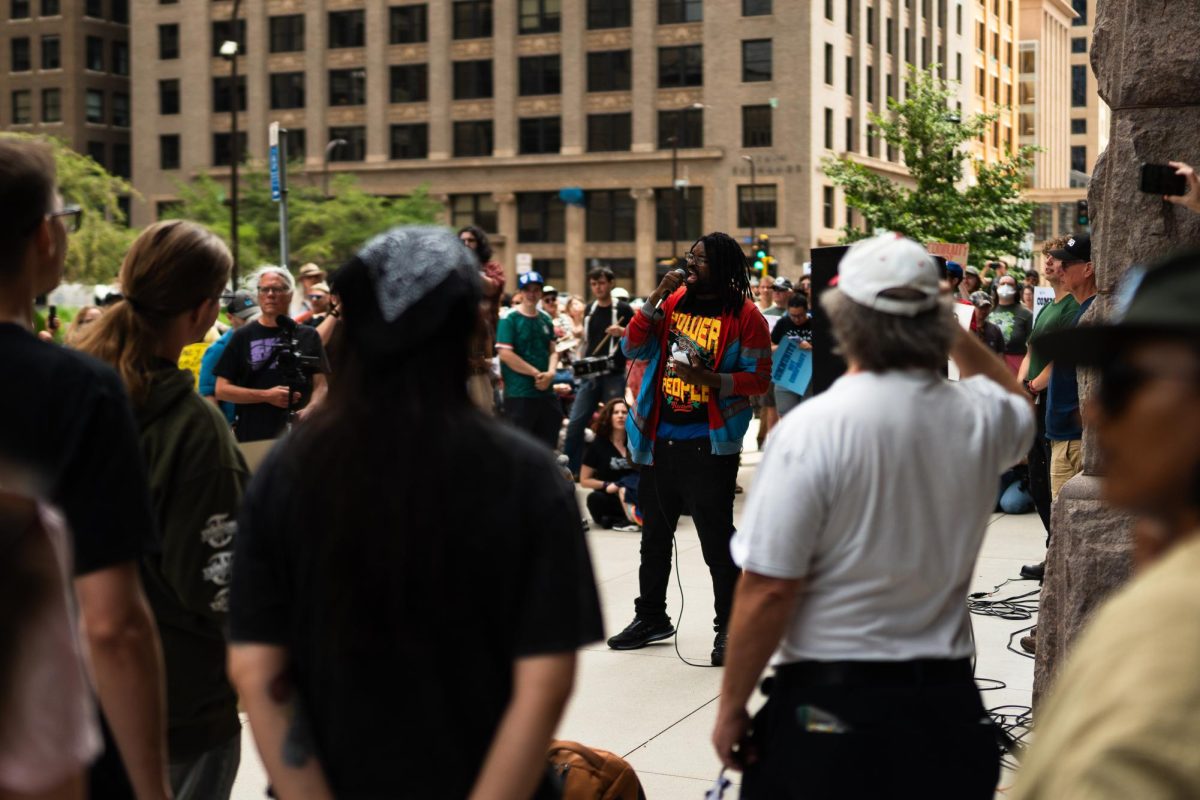
Following the Target picket, University of Minnesota student groups, such as the Somali Student Association and the Black Student Union, organized a march in downtown Minneapolis.

Community organizer Simon Elliott said there has been a trend of similar protests with students nationwide, as it originally started in Minnesota regarding the ICE operation.
“This has really taken off across the country, and people following the lead of students,” Elliott said. “Someone told me that over 100 high schools in the Atlanta area walked out, and that the Aurora Colorado school system had to close down or had to shut today because of all the teachers that were participating in the national shutdown.”
Although Border Patrol Officer Gregory Bovino left Minnesota, Elliott said the operation has still been detrimental to Minnesotans.
“They’re still kidnapping people, so what we’re demanding is that ICE leave Minnesota once and for all,” Elliot said.
February 6
During a protest on the steps of Morrill Hall, four students chained themselves to the building’s doors, calling for the University to impose sanctuary campus policies. Headed by the Sunrise Coalition, protesters urged the University to adopt guidelines to protect immigrant students from ICE enforcement on campus.
Locking themselves to the administrative hall, the students said they would not leave until University President Rebecca Cunningham met with them and began updating University policy.
Miles Martig, one of the students chained to the building, blasted the University’s response, saying the administration has ignored students’ concerns.
“They have refused to acknowledge ICE as a problem,” Martig said. “So we’re here to be in a place where they can’t ignore us. We’re blocking the front doors to Morrill Hall.”
Roughly two hours after they chained themselves to the building, UMPD officers arrested three of the four protesters, according to the Sunrise Movement. They were released shortly after their arrest.
“I expect that the University community and the people around me will stand by me, have my back,” Martig said. “We’ll get through it. We’ll get through that repression.”










KG
Feb 16, 2026 at 5:24 am
This timeline omits the unique confrontational vitriol that extremist “Palestine” activists have injected into the ICE protests. We saw keffiyehs and Palestinian flags indistinguishable from anti-ICE banners, placards reading “From Minnesota to Palestine,” and activists explicitly claiming immigration enforcement is merely a “distraction” from the “genocide in Gaza.”
This is not a coincidence. At the U, Students for Justice in Palestine (SJP) openly participated in the recent Morrill Hall “chain-in,” a tactic reminiscent of SDS’ takeover of Morrill Hall in October 2025 to “Free Palestine.” These are the same extremist groups that celebrated the fascist Hamas attack on democratic Israel on October 7, 2023, disrupting our research, teaching, and study, and creating a hostile environment for all of us over the past two years.
We remember the shooting out of Hillel’s windows and forced sheltering in place of Jewish students in the Hillel building during a demonstration. This rhetoric has real-world consequences beyond our campus. The weapon used in the tragic shooting at Annunciation School in August 2025 bore the slogans “Burn Israel,” “6 Million Wasn’t Enough,” and “Destroy HIAS”—a Jewish group that primarily aids non-Jewish immigrants.
We see here clearly how anti-Zionist messaging has morphed into outright Jew hatred. Antizionism is not politics. By seeking to sever the 3,000-year connection between the Jewish people and their ancestral homeland—effectively carving Israel out of the Jewish identity—it attacks the core of who the Jewish people are. That is Jew hatred.
Worthwhile causes should be wary of cooperating with extremist pro-Palestinian elements. This radical wing demonstrates no compunction about subverting other organizations and co-opting distinct missions to serve its antizionist agenda. Aligning with antizionism is aligning with Jew hatred. And as we saw, Jew hatred doesn’t stop at the Jews.