

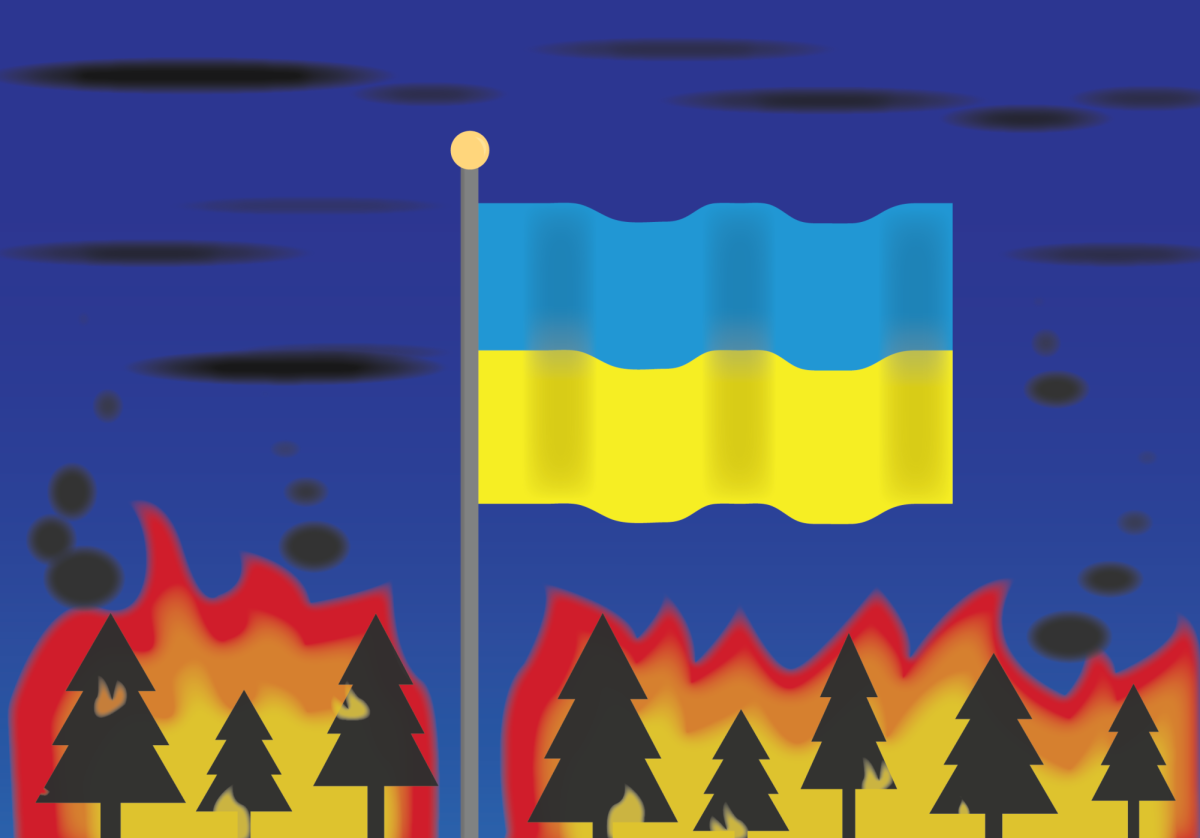
Four years ago, I was a bright-eyed, bushy-tailed high school sophomore who had just entered the realm of competitive speech and debate. While I wasn’t sure what exactly I wanted to do, a category called international extemporaneous speaking called out to me.
So, I started giving speeches on international politics every Saturday in the winter. I was given a topic and 30 minutes to research, prepare and practice a speech on world affairs. I gave at least three speeches every weekend meet.
As I began to analyze international politics, there was one topic that came up again and again in my prompts: The war in Ukraine. Russia had just begun its invasion of Ukraine, so it was popular for speakers to analyze the situation and try to predict how long the war would last.
Four years, a high school graduation and several college semesters later, the war still rages on. War analysts make maps that look eerily similar to those we speech competitors pored over years ago.
Given the size of their opponent, it’s safe to say Ukraine has done incredibly well to punch above its weight class and hold back Russia’s advances year after year. However, that does not mean that this war has been without cost.
University of Minnesota political science professor Ron Krebs said while the war has stagnated, it’s no secret that the massive social and economic effects of the war on Ukraine have put a damper on Ukrainian livelihood.
“The pressures on Ukraine are immense to bring this war to an end,” Krebs said. “But what you see clearly from President Zelenskyy is that he believes his hands are still politically pretty tied with regard to cutting some kind of deal that would permanently put Ukrainian territory in Russian hands.”
The immense cost of this war on the Ukrainian people cannot be understated. Just days ago, eleven people were killed in a series of strikes that set fire to an 11th-century cathedral in Kyiv.
According to the United Nations’ Human Rights Monitoring Mission in Ukraine, at least 274 civilians were killed and 1,763 were injured in May, the most monthly civilian casualties since April 2022.
As of February 2026, the UN High Commissioner for Refugees estimates 3.7 million Ukrainians are displaced within the nation, with another 5.9 million being refugees and 10.8 million requiring humanitarian assistance.
The military situation is similarly dire, with a Congressional Research Service report from last March detailing how the Ukrainian Armed Forces have largely expended their supply of ammunition and integral artillery systems, relying on foreign security assistance to make up for the shortfalls despite some progress made in building up a domestic manufacturing base.
As such, it’s a great sign that the Ukraine Support Act, a measure providing more than $1 billion in security and reconstruction aid and the potential for $8 billion more in loans alongside economic sanctions on Russia, passed the House after 18 Republicans broke ranks and supported the bill.
However, the bill remains controversial, with 195 House members, including Minnesota Rep. Ilhan Omar, opposing the bill.
In an email communication with the Daily, Omar’s staff highlighted a statement she posted to X, explaining her vote on the Ukraine Support Act was due to the inclusion of sanctions.
“I have always, and will continue, to stand with the Ukrainian people and unequivocally condemn Putin’s illegal and brutal invasion,” the statement said. “I voted against the Ukraine Support Act because of its inclusion of broad economic sanctions. Time and again, sanctions like these fail to achieve their stated goals while inflicting real suffering on ordinary people.”
The lengthy debate around the efficacy of sanctions aside, there is no denying that the massive effects of the war on all parts of Ukraine have left the nation in need of some kind of aid.
Unfortunately, the United States has practically disappeared from the charts tracking aid to Ukraine since the start of the second Trump administration, and, with the Ukraine Support Act unlikely to pass the Senate or get signed by the president, it’s unclear if U.S. aid to Ukraine will resume anytime in the near future.
Krebs said aid is a tough needle to thread, as too much aid might allow Ukrainian leaders to think they have a chance to regain all of their territories without compromising, while too little may lead to Ukraine losing bargaining power as Russian leaders refuse to compromise.
“It’s a delicate balancing act,” Krebs said. “Without external support, the Ukrainians would’ve had to fold and concede to the Russians long ago, and that would, I think, be very dangerous for global stability.”
Even if we failed to support Ukraine militarily, assisting with rebuilding and providing aid to refugees would still be a great and necessary way to support the nation. At the end of 2025, the World Bank estimated rebuilding Ukraine would take nearly $588 billion over the next decade, almost three times Ukraine’s annual nominal gross domestic product, which measures the sum of all goods and services produced within a nation’s borders.
At the end of the day, the U.S. cannot fix the world via foreign aid, and it cannot end the war in Ukraine on its own either. However, some well-placed assistance to a foreign country invaded by an authoritarian power is the least we can do to assert our interest in preserving the world order.
I believe Republican Rep. Don Bacon of Nebraska said it best while expressing his approval for the Ukraine Support Act.
“This is our Churchill moment or our Chamberlain moment,” Bacon said. “And by God, I’m going to choose Churchill.”







anonymous
Jun 24, 2026 at 8:53 am
No it’s not. Not when students are climbing through debt, we don’t have universal healthcare, and our tax dollars are being used against us. We don’t need to be the world police for a conflict that’s actually not as black-and-white as the corporate media has groomed our youth to believe. End the fucking war, stop the slaughter of Ukrainians and Russians, and sideline anyone, including this author, who wants to use our tax dollars for proxy wars or any war or genocide.