Minnesota Gopher women’s hockey does not need to imagine what a championship program looks like. It has already happened seven times.
Now, history hangs over the program with Minnesota not having played in a national title game since 2019. It is a drought that feels longer in a program built on championships. There is no uncertainty about what the ceiling can be, but there is the question of how to reach it again.
When Mark Coyle introduced Greg “Boom” May as the program’s next head coach, the message was made clear that it was not about building something new. It was about getting back.
“Every time you do one of these press conferences, you’re always excited because it’s a new day for a program,” Coyle said.
The search for the next head coach started nationwide, spanning across many influential voices in women’s hockey. As the process unfolded, it all kept circling back to someone who was already behind their bench.
“The one name that kept coming up was Boom,” Coyle said.
May is far from an outsider. He spent the last three years on Brad Frost’s coaching staff, close enough to understand both the strengths and the shortcomings. His balance of having program familiarity without attachment became part of the appeal.
The biggest selling point for Coyle was that May understood the problem. He knows Minnesota has talent and depth. He has seen the team show up to beat top teams on the right night. He has been behind the bench when the Gophers have come close, but fallen short of making the title game. That is why he understands that in a program like this, close is not enough.
“We’re close, and we have been close,” May said. “But unfortunately, close isn’t what we want here at Minnesota.”
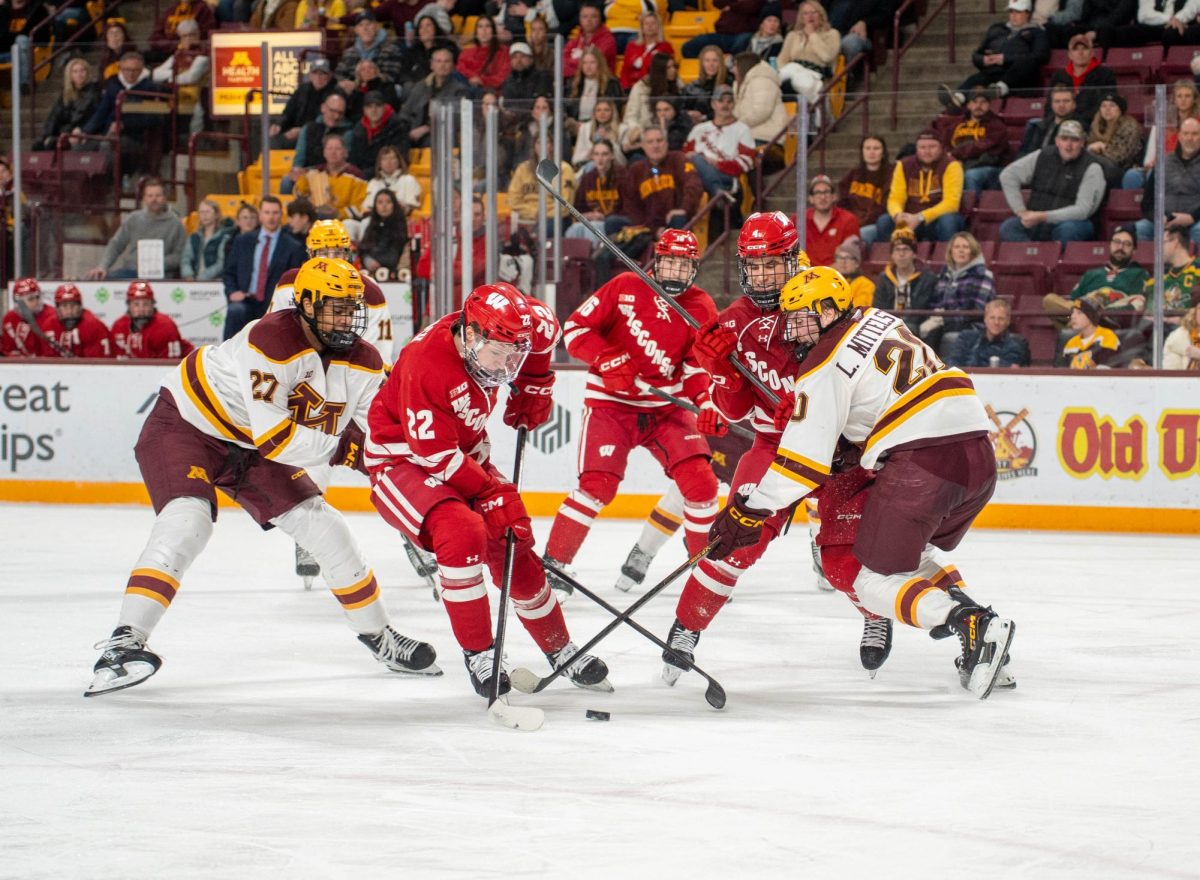
This growing gap is most visible when measured against the teams that have taken their place at the top. Ohio State University and the University of Wisconsin have won, and they have done so by developing strong identities that remain no matter who is on the team.
Wisconsin is known to overwhelm opponents with skill, while Ohio State plays with relentless pressure and physicality.
“You just know exactly what you’re going to get every time you play against a team like that,” May said.
Minnesota has not offered that consistent identity in recent years, not across the stretch of a full season. That is where May’s vision begins. He looks to reboot the program with a fresh voice and fresh expectations.
He believes the foundation of the program is still strong — they are still a skilled and fast team. They have an identity. They are just looking to change what supports it.
“If we want to be champions, we need to start acting like champions, practicing like champions, and training like champions,” May said.
It is going to be a shift in standard rather than playing style. May wants to bring consistency that does not get challenged, depending on the opponent or moment.
That sense of urgency and winning edge are what drew Coyle to May immediately.
“He’s competitive,” Coyle said. “And I felt like we need a sense of urgency with our women’s hockey program. He has that sense of urgency.”
May’s urgency and competitiveness showed up most in how May handled Coyle’s central question about closing the gap between them, the Buckeyes and the Badgers.
“We’ve got a lot of respect for Wisconsin, a lot of respect for Ohio State,” Coyle said. “But we need to compete at that level. And he didn’t back away from that.”
The challenge might end up being cultural more than logistical. Change is not always comfortable, but that is not a major concern for May. The end goal is the focus, even if it will not be easy.
“It’s probably not going to be comfortable at times for our players,” May said. “But we know what we want and that’s championships.”
Minnesota is making the bet that May’s accountability and urgency can turn coming close into a championship. Here, it is clear progress is not the goal. Getting back to the winning standard is.