

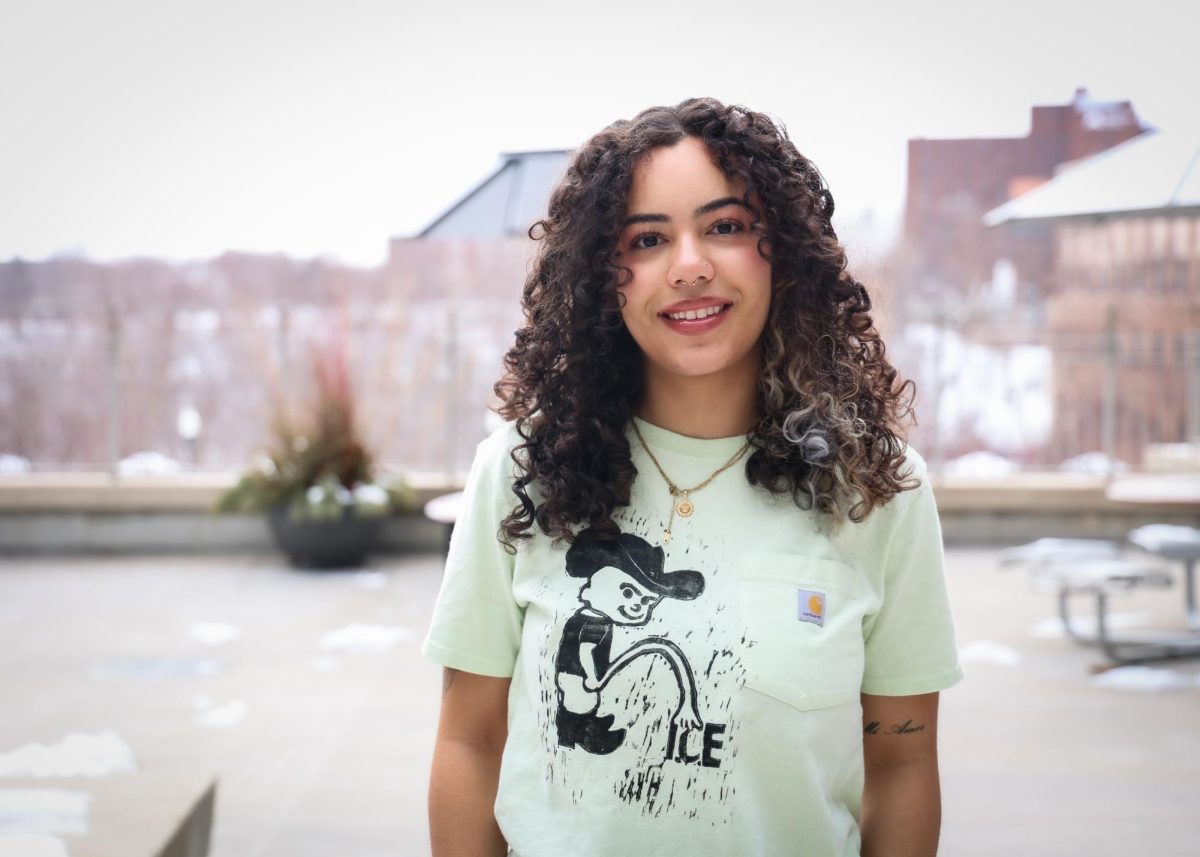
Some people wear their hearts on their sleeves. Others design, print and wear protest messages across their chests.
Soleil Anthony, a third-year developmental psychology and art student at the University of Minnesota, has transformed her art into activism, creating and distributing anti-ICE shirts free of charge to anyone who asks.
Purpose
This project picked up speed following the start of Operation Metro Surge, a mass deportation effort that brought more than 3,000 Immigration and Customs Enforcement and other federal agents to Minnesota.
Since they arrived in the state in December, federal agents have arrested nearly 4,000 people, shooting three and killing two, Renée Good and Alex Pretti. This has resulted in a wave of statewide protests and strikes, as well as increased community efforts to protect vulnerable neighbors.
Anthony made the print before ICE came to Minneapolis, but it wasn’t until they arrived that she decided to do something with it.
“I just kind of felt like there’s nothing I can do about this,” Anthony said. “So, I thought that making the shirts and giving them away could be a form of resistance that isn’t directly me out there protesting, because to be honest, I’m scared to do that.”
For her, this project has personal significance: her mother is an Argentinian immigrant.
Despite how close to home it feels, Anthony believes as much as ever that this project matters.
“Making art during times like this feels a lot more important than making art during peaceful times,” Anthony said. “Especially using it as a way to process what’s happening.”
According to Anthony’s friends, offering the shirts free of charge was a way for her to prioritize her community. While she initially planned to charge $15 a shirt, she eventually decided to give them away.
“Soleil has always been very human rights oriented,” Charley Norcross said, a third-year student and Anthony’s friend. “I think she’s always been very progressive thinking about her community, wanting to serve her community.”
Her process
The shirts have been a labor of love from the beginning.
Anthony prints onto the shirts using a woodblock relief technique. While in her introduction to printmaking class, she carved the design she’d later use on the shirts into the surface of a block of wood.
The raised surface on the woodblock catches the ink and transfers it to the shirts, while the chiseled divots become the highlights after printing.
To transfer the woodblock-carved graphic onto fabric, Anthony utilizes the presses in the printmaking studio in the Regis Center for Art on West Bank. She places the blank shirts on the bed of the press, sets the ink-covered block over top of it and rolls the printing wheel to apply pressure and transfer the ink.
The woodblock printing method enables Anthony to create consistently high-quality shirts.
“You can make a lot of copies, but they still all have the quality of an original, so they’re a lot less expensive,” visiting professor in printmaking Stephanie Hunder said. “And then also, if you have an important message to get out, you can make multiple copies.”
Hunder was Anthony’s professor for the introduction to printmaking class, and she watched as Anthony’s passions blossomed outside of the classroom.
“She found a reason to come in and work on her own projects that weren’t part of the class,” Hunder said. “She had a lot to say.”
Anthony purchases and uses her own materials for the project. She sources shirts from the Goodwill Bins, the pay-by-the-pound Goodwill outlet centers, and prints using fabric ink, which is specially designed to last longer on clothing than other inks.
Anthony saw a sculpture online that inspired the design, so she tweaked some aspects and made it two-dimensional for the print.
The design itself is playful, which Anthony intentionally tried to evoke. To her, it counterbalances the severity of the topic.
“I feel like the humor of the shirt is kind of also an important part,” Anthony said. “It’s a really heavy topic and a heavy thing to discuss, but I feel like the shirt’s kind of silly.”
Community support
Since Anthony did her first print run, she’s received support from all over.
“When I said I’d be giving the shirts out for free, I got so many DMs,” Anthony said. “I was kind of shocked that so many people wanted to be part of the message that ICE doesn’t belong here. We love our neighbors.”
When they come to pick up the shirts, most people grab multiple to give to their friends, Anthony said. A lot of them have expressed interest in this unique form of art.
“Clothing is always a method of expression anyway, so I think it’s cool to combine that with activism,” Anthony’s friend Adella Mulawarman said, another third-year student at the University. “People find a lot of meaning in how they present it, things that they wear.”
The shirts also present the opportunity to always transmit a message.
“You can’t always just bring a poster board with you everywhere you go,” Norcross said. “But you can just have your shirt on.”
To Hunder, Anthony’s shirt printing gets at a crucial point of art: it interrogates the world and prompts people who see the shirts to question ICE’s presence in the Twin Cities.
“Art isn’t just about being pretty or pleasing. Art should be about asking questions and discovery, you’re proposing ideas,” Hunder said.
For now, Anthony has no plans of stopping her project. If she can get her hands on the materials, she said she’s looking forward to creating even more designs.








TA
Feb 26, 2026 at 11:05 am
Wow so brave and important and boundary pushing!
You mean art can also be cliched “activism”?? What a scoop!
Berni Sarazine
Feb 23, 2026 at 10:27 am
I will pay for a shirt 2X if possible
My email is saraz038@umn.,edu
It’s a great piece of art!