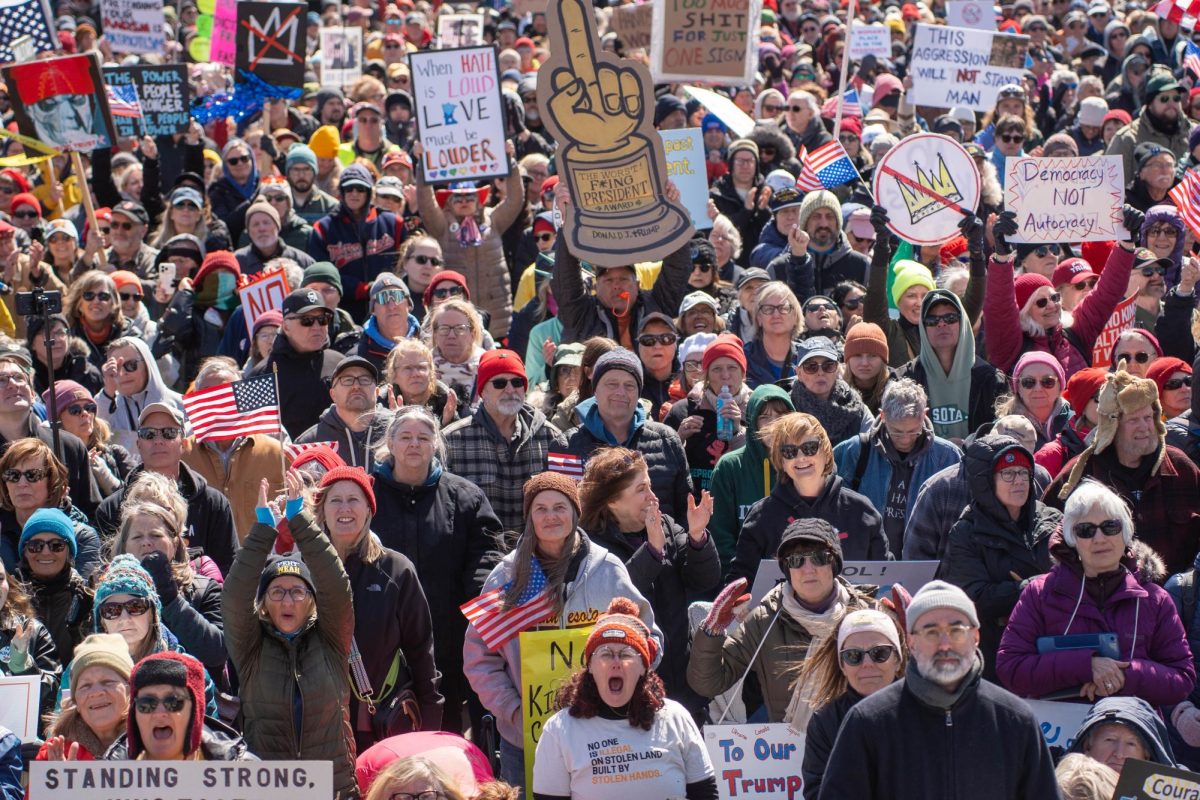
Outside Coffman Union on March 3, The University of Minnesota’s Students for a Democratic Society protested Immigration and Customs Enforcement’s presence in Minnesota and on campus, despite reports that Operation Metro Surge ended. They believe the University has not appropriately addressed student concerns about ICE and their fear for everyone’s safety.
Sasmit Rahman, a University alumnus and member of the organization, voiced their concerns.
“While it is true that the formal operation has ended, we know from being in community with broader Minneapolis that ICE is still here, these kidnappings are still happening, and the threat of ICE terror has not gone away,” Rahman said. “We feel that the University has not appropriately addressed the concerns of students, and the very real threats that university students face when ICE is on campus.”
In the wake of the protest, Rahman reflects on the University having a meme depicting former Secretary of Homeland Security Kristi Noem disfigured from the animated comedy series, South Park.
“So many people, I think, feel voiceless, and pop culture is a way that they can gain that voice,” Rahman said. “I think the fact that South Park has been this very satirical show doesn’t take away from the kind of joke. I think it’s the writers recognizing that there is a very widespread frustration with ICE and the Trump administration, and satirizing them is a very easy way to resonate with young people.”
Ruth DeFoster, an assistant professor at the Hubbard School of Journalism and Mass Communication, said memes have always been a way to aim satire at the powerful.
“(Memes) are the spiritual successor to editorial cartoons in that way, and throughout human history, we’ve always used caricatures as a way to lampoon the powerful,” DeFoster said. “I think that’s what we’re seeing here with Kristi Noem.”
When asked if the meme added perspective when DeFoster objected to Noem’s response to the shooting of Alex Pretti, she only found it to be a general expression of displeasure with her leadership.

“I’m on the record saying that Noem and this administration do not understand the federal law around domestic terrorism because they identified Alex Pretti as a domestic terrorist,” DeFoster said. “There’s no question that federal law does not identify him as a terrorist.”
Besides the South Park meme, longtime musician Bruce Springsteen released a single, “Streets of Minneapolis,” in response to ICE activity in Minnesota.
Rahman found the song very powerful.
“I don’t personally listen to Bruce Springsteen very much,” Rahman said. “I think that the fact that he made this song at all is really indicative that this struggle in Minneapolis is impacting the whole nation, seeing what they’re doing to one city.”
They see art and music as a way to cope and connect.
“ICE is an issue that really pervades all aspects of life for the people in Minneapolis and hasn’t really left the news since the occupation started in December,” Rahman said. “It speaks to people’s frustrations with the federal government, with these kinds of false divisions being placed among immigrants and non-immigrants, and art and music is one way of coping and connecting.”
DeFoster shared similar thoughts.
“Protest music has a really long history in the United States. For Bruce Springsteen, whose work has always been political, I think it’s the natural evolution of his legacy.” DeFoster said. “Anecdotally, I know a lot of my friends who live in Minneapolis felt very seen by that song, felt very touched that somebody of his caliber would talk about what was happening here.”
Beth Hartman, a senior writing studies lecturer and band manager of The Gated Community, finds the song to be no small thing.
“Many Minnesotans (including me) were moved by ‘Streets of Minneapolis’ when it came out. Springsteen helped convey what was happening here–not sometime down the road, but fairly immediately, during the height of the horrors of Operation Metro Surge,” Hartman said. “This sense of urgency was meaningful in and of itself, as was Springsteen’s dedication to the people of Minneapolis.”
Hartman said to hear Springsteen sing about efforts in Minneapolis and to have him acknowledge the murders of Renee Good and Alex Pretti was no small thing.
Springsteen made a surprise appearance at the Minneapolis First Avenue Venue on Jan 30, and will perform again at the Target Center on March 31.
DeFoster said Springsteen’s upcoming appearance was gratifying for local community members.
“He knows how to respond, which is to create an anthem, which is to create something musical,” DeFoster said. “I think choosing to write the song and then choosing to show up here in person, to perform it in solidarity, is really a signal.”
Hartman said he hopes the cameras will come back with Springsteen.
“When Springsteen decides to use his platform and his music to draw attention to a social justice and human rights issue like the ICE occupation of Minneapolis, people listen,” Hartman said. “On Jan. 30th, not even a week after ICE agents murdered Alex Pretti, Springsteen’s surprise performance at First Ave. yielded a good amount of local and national press coverage. Now, nearly two months later, most national news outlets have moved on. But ICE is still here. People are still afraid. And the impact of ‘Operation Metro Surge’ will be long-lasting. So when Springsteen returns again at the end of this month, I hope the cameras come back with him.”
Rahman said art can be a source of hope for a community that has faced so many trials and tribulations.
“As the news or the presence of ICE starts to wind down in the city, and the news covers it less and less, it becomes even more important for us to stay connected, stay together, and really protect our neighbors and everything that we’ve been fighting so hard for these last couple of months,” Rahman said. “And I think by creating art, by creating music, by finding levity in these extremely dark and scary times, hopefully we’ll be able to start healing as a community.”