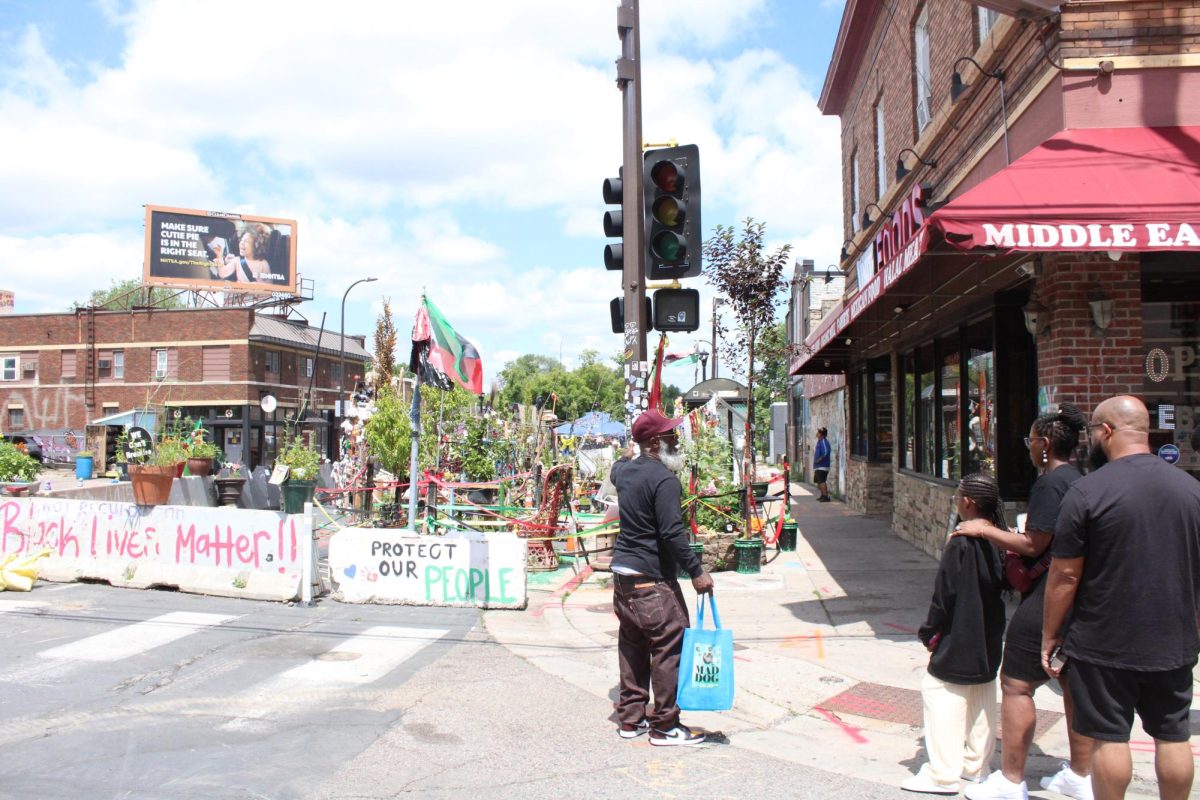
Marquise Bowie, the self-proclaimed “Tourist Interrupter” of George Floyd Square, often sits near Floyd’s memorial in Bichota Coffee Shop, reading the Star Tribune and watching for visitors.
Minneapolis Police Officer Derek Chauvin murdered George Floyd in May of 2020 in South Minneapolis after Floyd was accused of paying with a counterfeit $20 bill. Floyd’s murder led to mass protests across Minnesota and the nation and transformed the intersection where he died into a memorial that draws visitors every year.
When Bowie sees people walking by, he said a sixth sense goes off. He leaves the newspaper and heads outside to introduce himself. More often than not, the people he meets are from out of town.
Nearly every day, people from across the country travel to George Floyd Square to pay their respects. Now, they also stop by the memorials of Renee Good and Alex Pretti, who were shot and killed by U.S. Immigration and Customs Enforcement officers in January. For travelers, the visit is a way to better understand the impacts of their deaths.
Bowie said he uses his tours as an opportunity to help visitors understand the weight of the space and Floyd’s murder.
“I use it as an opportunity to talk to people, get them out of the ‘tourist in Minnesota’ because this is not the cherry spoon at the Walker Art Center,” Bowie said. “This is a murder scene, to realize that people are coming from places where this same exact thing took place.”
The Patterson Family, one of many out-of-town visitors, came from Memphis, Tennessee, in late June. Bowie guided their tour, providing context about the neighborhood’s history, murals and his own life in south Minneapolis.
Before the end of the Pattersons’ tour, Bowie handed out a $20 bill for them to pass around and decide whether the bill was real or fake. He performs this test with visitors frequently.

Dominique Patterson said she visited George Floyd’s memorial because, outside of Minneapolis native and famed musician Prince, this is what she knew of the city.
“This was one of the most historical things that Minneapolis had,” Patterson said. “ I didn’t know anything about Minneapolis.”
Patterson said the weight of seeing the George Floyd memorial is heavy.
“It runs deep, the feeling just being in the same exact spot,” Patterson said.
Big L’s Soul Food and Steakhouse in Minneapolis is located across the street from Floyd’s memorial. Its owner, Larry Robinson, said the visitors keep the memory of George Floyd alive.
“I see tours out here every day, it’s almost like it just happened yesterday,” Robinson said. “It brings the memory back.”
Bowie said while visitors come to pay their respects, bringing items that show respect has slowed down over the years.
“I have not met a person that didn’t say they were coming here to pay respects, but to see only a few people bring flowers,” Bowie said. “Most of the stuff is two, three, four years old.”
New York artist Marshall Weber visited Pretti’s memorial. Since federal agents killed both Pretti and Good, their memorials have become a place of reflection for many after Operation Metro Surge.
Weber said, today, the memorials are personal expressions of the community.
“This is not institutional expression, this is the expression of individual people,” Weber said.
Good’s memorial is less than a mile away from Floyd’s. Pretti’s memorial is located just over a mile from Good’s.
Johanna Richwagen, traveling cross-country with her family, visited Good’s memorial. She said that the impact is ever-present.
“I think you can’t walk down the street without feeling it fully in your body,” Richwagen said. “I feel deep sorrow for the families and the loved ones of Renee, Alex and George, but also this community, because this place will be forever changed.”
Weber said seeing Pretti’s memorial inspired him to continue with his activism. He views the memorial as a potential alternative to violence.
“This isn’t pessimism, this is optimism, this is people trying to honor the legacy of love and Pretti by saying, ‘Hey, we need to continue this fight’,” Weber said. “We need to honor them, their deaths. We need to honor their sacrifices.”