

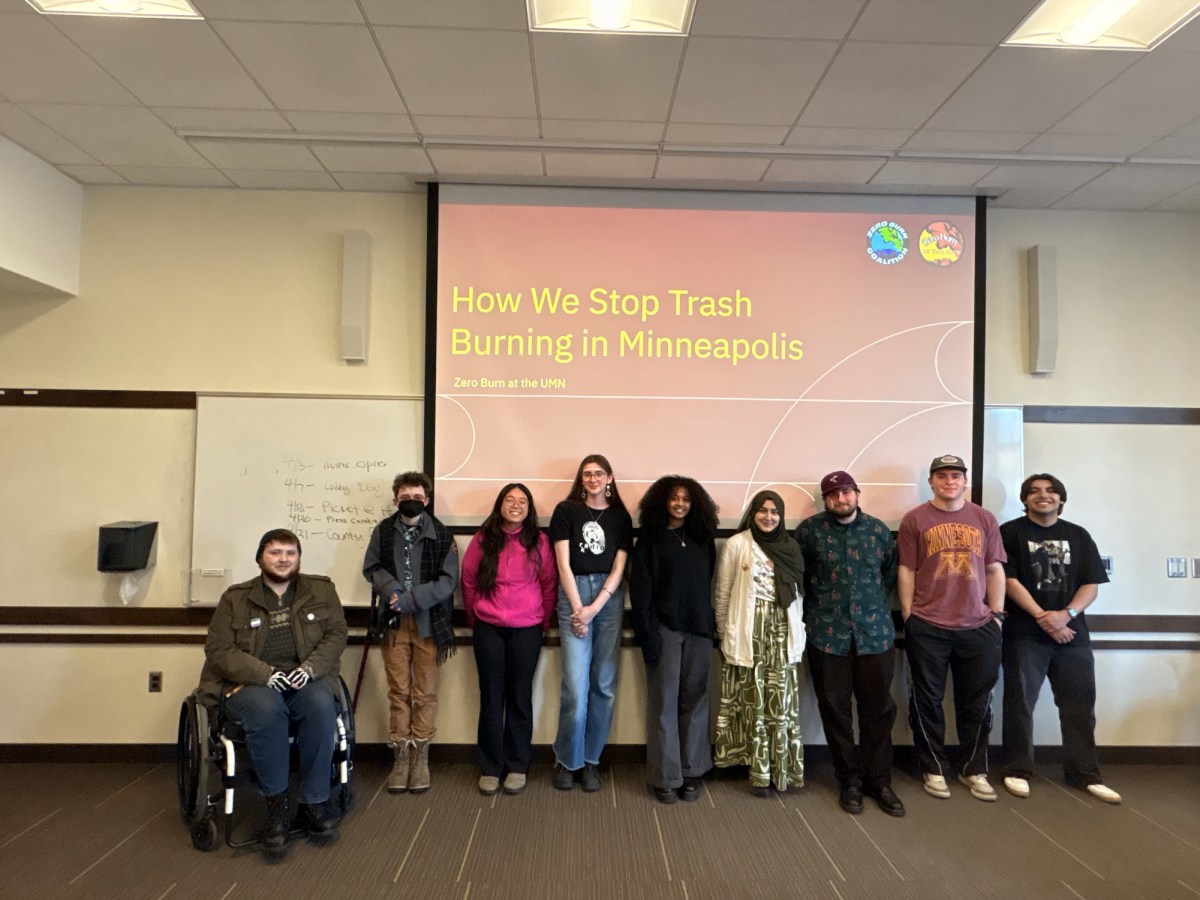
The University of Minnesota’s Zero Burn Coalition is fighting to shut down the trash incinerators and the Minneapolis Hennepin Energy Recovery Center, as representatives say the pollution they create could cause major health detriments to locals.
Created in early March, the student organization is a branch of the local Zero Burn Coalition organization, which is an activist organization based in Minnesota who have pushed to end trash burning. While they are focusing their efforts on HERC, the student organization also aims to speak to Hennepin County Commissioner Angela Conley, as she differs in how to achieve the organization’s goals.
Second-year student Arwa Alakech is currently the president of the UMN Zero Burn Coalition and created the University branch to spread awareness. As Zero Burn Coalition activists across Minneapolis are fighting to shut down the HERC, Alakech hopes to boost support on campus.
“I wanted to make one specifically just to focus on the Zero Burn movement, because that’s the one that’s going to shut down the trash incinerator,” Alakech said. “The reason that I care about it and the reason that the University of Minnesota students should care about is because the University of Minnesota sends their trash to the trash incinerator that pollutes their neighbors.”
Alakech said she is disappointed in the University for not speaking up about the environmental issues surrounding campus, and she hopes that students can separate themselves from the administration to make their voice heard.
“I wish the University was able to take a stance and not just lay flat whenever anything happens,” Alakech said. “I hope to see the University of Minnesota students branch out from the University of Minnesota, because clearly we aren’t going to get no response from the administration.”
Nichole Jacquez, a fourth-year student and a collaborative member of the organization, said the trash from the University campus and the city of Minneapolis is being disposed of at the HERC, which gives students a reason to care.
“All of the U’s trash gets sent to the HERC,” Jacquez said. “As well as, most of the trash and the city in the county gets sent there and they receive hundreds of thousands of pounds of trash that they just incinerate on the city and it’s located sort of near the Target Field.”
Jacquez said people are dismissing the trash incinerator’s possible downsides. He said it could cause health effects in the nearby communities.
According to CBS Minnesota, the Zero Burn Coalition is planning to go on a hunger strike in April. 10 in an effort to shut the trash incinerators down. Alakech said the student group is not going to partake in the strike, but is planning to support them in different ways, including hosting a flyering event.
Zak Bhatti, a first-year student and a member of the organization, said the community that is mostly affected by the HERC is people of color, as the facility is located in North Minneapolis.
“It’s in a predominantly BIPOC community, more people of color and poorer communities is where the HERC was first implemented or established back in the 1990s,” Bhatti said.
According to Zero Burn Coalition documents, the HERC was created in 1989.
Andy Yang, a fourth-year student and a member of the Zero Burn Coalition, said the organization has to focus on the cause of the issues that impact people’s health.
For Yang, health equity doesn’t start at a hospital. It starts with fixing systems that cause disparity.
“It’s important that we address the root problems itself because if we don’t, it’s incomplete care,” Yang said. “Obviously, that means confronting the policies and the systems in the first place that caused these health effects.”
Clarification: An earlier version of the article incorrectly states that Hennepin County Commissioner Angela Conley is opposed to the Zero Burn Coalition’s goals. This is incorrect – Conley differs on the closure date of the incinerator, yet still seeks to accelerate zero waste policy.







set a date, Conley
Apr 11, 2026 at 4:00 pm
From the article: “Clarification: Conley differs on the closure date of the incinerator, yet still seeks to accelerate zero waste policy.”
Conley and the Board need to actually SET A DATE to close the HERC. They should be accelerating HERC’s closure on their way to zero waste. Nothing is stopping the Board from setting a date except that they put profit over people and planet. Conley and the Board clearly don’t mind sacrificing the health of our neighbors.
Northsiders are literally on a hunger strike because Conley and the Board have blah, blah, blahed for YEARS about this with no action. What an embarrassingly non-responsive County Board that their constituents have to go on hunger strike to get things done. Stand up, for pete’s sake!! It’s your planet, too, after all.
ShutItDown
Apr 4, 2026 at 1:17 pm
Thank you, UMN Zero Burn! You are part of a powerful coalition that will win!!
Tom Sheasby
Apr 1, 2026 at 2:32 pm
To approach this problem responsibly (yes, I agree it’s a problem)
you must, make that MUST do a thorough Cost-Benefit Analysis before you can proceed with any ‘grownup’ credibility. Otherwise, you are nothing more than a bunch of attention-seeking, activist wannabes.
Find someone with economics’ chops… like someone in the Carlson School who can explain things like spillover costs, externalities, comparative technological contrasting and comparing and stuff like that. It’s called “due diligence” in big people pants. It beats being labeled as virtue signaling grandstander’s and might even give Minnesota the biggest bang for their environmentalist buck.