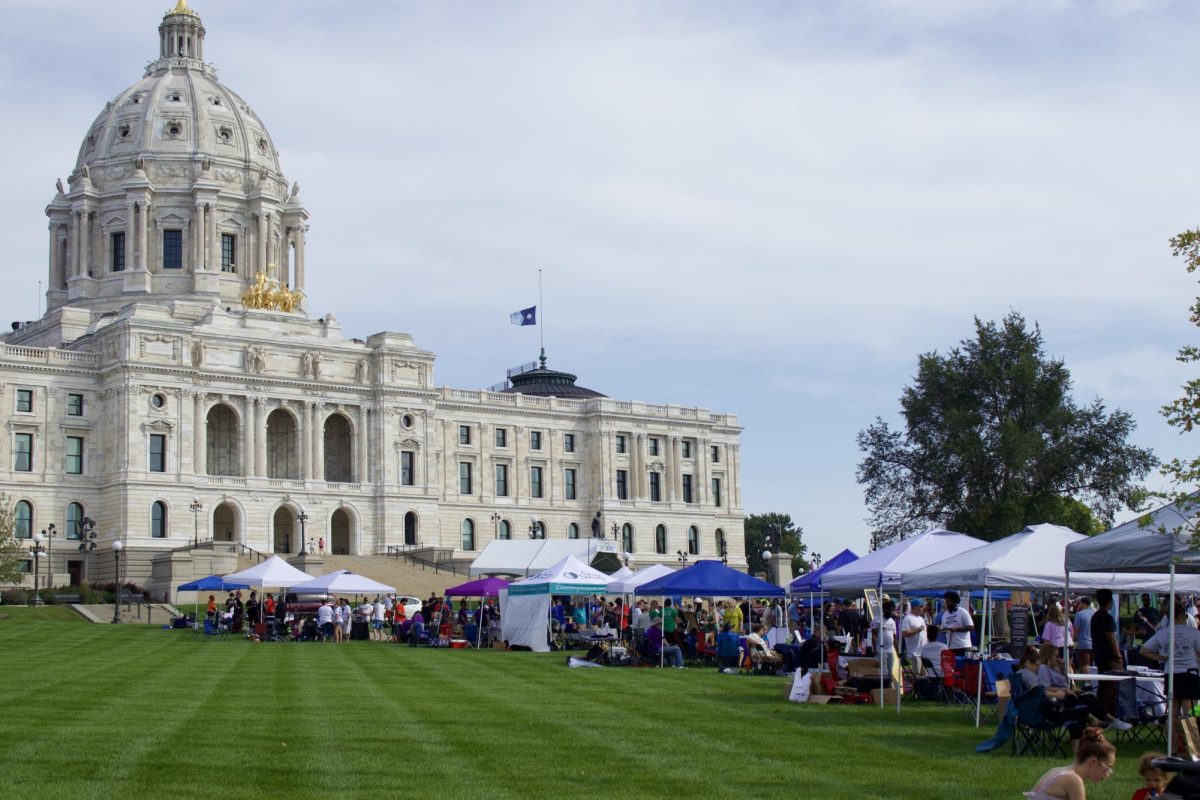
The colorful tops of canopies dotted the Minnesota Capitol building’s green lawn Saturday as thousands gathered for Minnesota Recovery Connection’s annual Walk for Recovery.
Beneath their shade, more than 100 recovery organizations, treatment centers, colleges and health care providers spoke with attendees walking the lawn’s sidewalks.
MRC is an organization led by people in long-term addiction recovery, Cynthia Munguia, executive director of MRC said. The organization is not a treatment center but functions as an advocacy group and supportive community to connect people to peer support and recovery services.
The Walk for Recovery started in 2011 at Lake of the Isles in Minneapolis to honor National Recovery Month. Since then, the event has grown significantly, said Munguia, who joined the organization in 2016.
“We want to strengthen our community,” Munguia said. “We want to envision a world where recovery from addiction is understood, is promoted, embraced and enjoyed.”
Under a large white canopy near the Capitol steps, a band played as Tom Johnson, who had attended the event several times, sat on a sunny patch of grass and watched. Nine years ago, Johnson volunteered at the walk while in early recovery.
“We’ve all got a common interest here,” Johnson said. “Living a good life where we do not have to turn to substances, spending or food, it is just an incredible way to live.”
Johnson works for the Minnesota Department of Human Services, which supports programs that serve people struggling with addiction.
“I was in a spot in my life where I needed the services,” Johnson said. “Now, I am in a spot where I can actually go to a job and give back to the community that saved me.”
On the outskirts of the lawn, orange traffic barriers blocked off Rev. Dr. Martin Luther King Jr. Boulevard as 10 food trucks lined the curb. Volunteers stood under a purple canopy in front of the trucks and greeted people as they arrived.
In front of the MRC table, a large whiteboard read in purple letters: “Recovery is important to me because…”
One answer, written in blue marker, read “I have myself for once #RecoverOutLoud!” Another, next to a drawing of a heart, read, “It saved my mom.”
Ryahn Spece, who worked in the recovery field for eight years, sat on a nearby curb enjoying food truck egg rolls. She said she was drawn to the work after two of her best friends from high school became addicted to drugs.
“I love running into past clients I’ve worked with,” Spece said. “Seeing that they are still sober and that they are happy and healthy.”
Spece said she has been to the event almost every year and watched it grow. The first festival in 2011 was just one food truck, one band and around twenty organizations.
“It’s open, it’s friendly, it’s honest,” Spece said. “It is beautiful to see the connections you can make.”
Kenna Thompson, a first-time volunteer for Nystrom & Associates, a mental health clinic with services throughout Minnesota, said she immediately noticed the strong sense of community.
“It is people coming together,” Thompson said. “Whether it is them in recovery, family members or friends.”
Caddy Frink, who trains peer recovery specialists at MRC, said the event is also a great way to connect people struggling with addiction to resources.
“They can walk in and go up to 100 different organizations and say ‘What do you do and why do you do it?’” Frink said. “It just brings education to it versus fear and misunderstanding.”
Frink said she joined MRC to give back to the community that gave back to her during her recovery, and many of the peer specialists she trains echo that motivation.
“It can change a life,” Frink said. “It can change a family, and it can ultimately change a community.”
At the MRC booth, one orange pin read “Families Recover Together.” Nearby, strollers rolled and dogs walked between booths, kids jumped in a colorful bounce house, while others sat getting free face painting.
Attendees gathered around 1 p.m. on the Capitol steps for a group photo. Afterwards, attendees, families, friends and volunteers all set out on the walk together, circling about a mile around the Capitol grounds.
“At an event like this, people realize that recovery and addiction do not have to own you,” Munguia said. “It can be something you get to take back, your recovery, your personhood.”