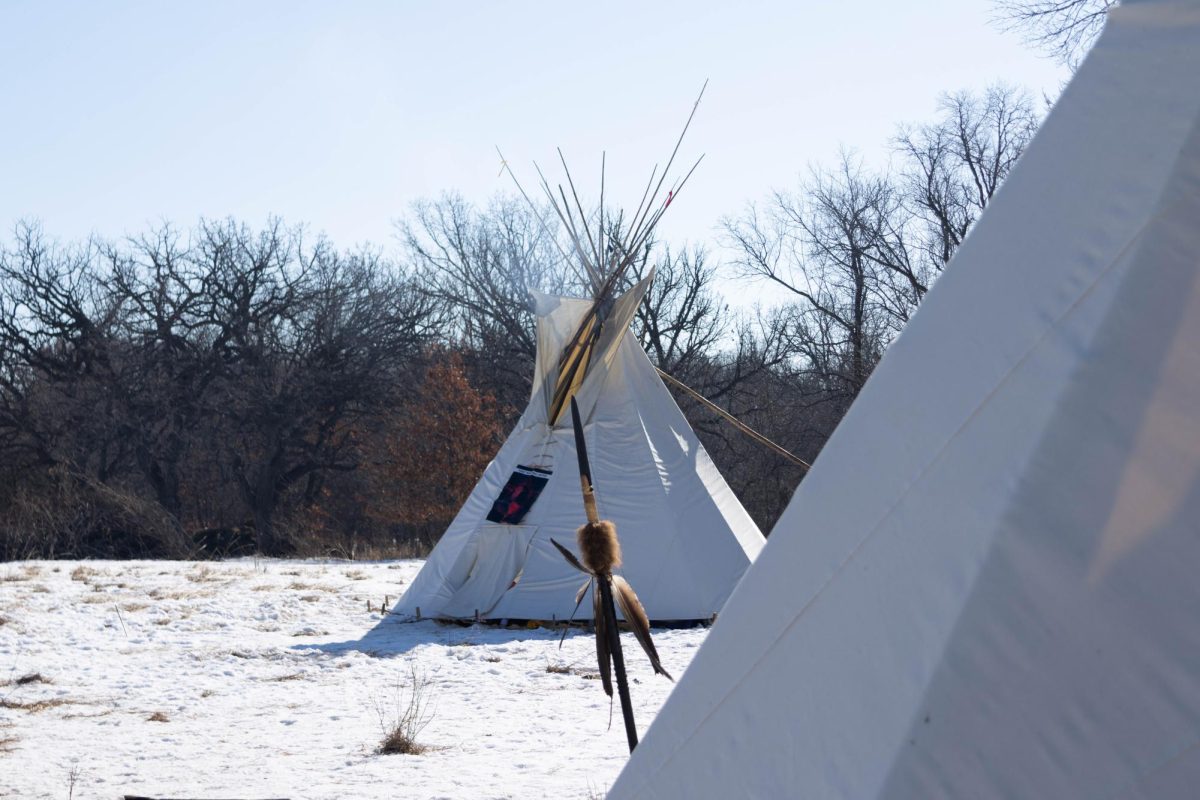
A sacred fire sits at the center of an Indigenous community living in a handful of tipis and yurts at Mni Owe Sni, or Coldwater Springs, in Minneapolis.
The fire, or Peta Wakan, is always lit, camp leader and Dakota tribe member Wasuduta said. Through the fire, prayers are sent to people detained inside the Bishop Henry Whipple Federal Building by U.S. Federal Immigration and Customs Enforcement.
“What you’re extending in prayer becomes greater,” Wasuduta said. “It goes to the ancestors, the spirits, the creator above.”
The Whipple building, sitting less than two miles from Mni Owe Sni, can be clearly seen from the camp. Whipple has been a constant point of contention between ICE and community members, as undocumented immigrants and U.S. citizens continue to be detained there.
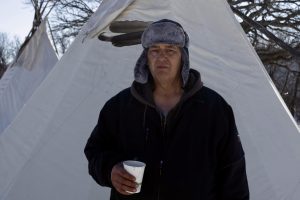
Wasuduta helped set up the camp on Feb. 9. Four days later, on Friday, people had established multiple tipis, yurts, a large pile of firewood and a kitchen.
Friday’s warm morning sun shone on people as they poured coffee for each other, ate breakfast and gathered around the fire. Traditional healing medicines like sage surrounded the fire.
Wasuduta said the camp is not a protest or an activist movement, but a statement of re-sovereignty through a return home to sacred Dakota land.
The camp is located at Bdote, the sacred confluence of the Mississippi and Minnesota rivers and the creation point for the Dakota people. The Dakota people are part of the Oceti Ṡakowiŋ, or the Seven Council Fires, which teaches that all land and water are sacred. Indigenous people have gathered at Mni Owe Sni for thousands of years.
The first tipi enacted at the camp faces west toward the portal where Dakota people return home after death, Wasuduta said.
“This has to be understood as our spiritual and cultural way of life,” Wasuduta said. “It’s not just something that popped up yesterday because someone sent a DM. This is thousands of years before they even came and made a treaty.”
The U.S. Army built Fort Snelling about two miles away from Mni Owe Sni in the 1820s, according to the Minnesota Historical Society. After the Dakota War of 1862, sparked by the U.S. government violating treaty agreements, more than 1,600 Dakota people were moved into a concentration camp at Snelling.
This camp is a call for land back, as it is the inherent right of the Dakota people to gather there, said Steve Vizenor, a member of the Ojibwe White Earth Nation. Vizenor arrived at the camp Friday morning and said it is a place to share stories, skills and ceremonies.
There is a constant trickle of community members, both Indigenous and non-Indigenous, who have come to pray and bring firewood.
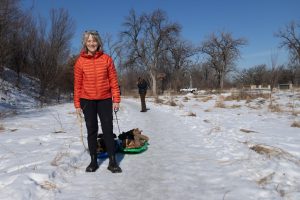
Michelle Cochran traveled from Winona and dragged firewood on a sled through the snowy path leading to the camp. Cochran is a literary specialist at Rochester Community and Technical College and works with many immigrant students, including one whose father was deported.
Amiee Elizabeth and Kate Roberts, both from Minneapolis, headed over to the fire to pray after bringing a firepit donated through their neighborhood network to the camp.
Elizabeth said prayer matters because she believes all humans are energetically connected.
“I pray regularly,” Elizabeth said. “Not in the whole religious Christian sense. My prayers are always for grace. I think of it as concentric circles of grace, starting very hyperlocal and moving out from there.”
Roberts said prayer is a way to support each other and be in community.
“The prayers take it out of the political sphere,” Roberts said. “It leaves all that petty stuff behind. This is what really matters.”
Everyone is welcome to come pray around the fire, Wasuduta said. There is no end date for the camp, or to the fire.
“My heart’s connected to that fire,” Wasuduta said. “So with what’s going on here, everybody wants to know when you’re leaving, all this and that. Well, we left a long time ago, and we’re returning home.”