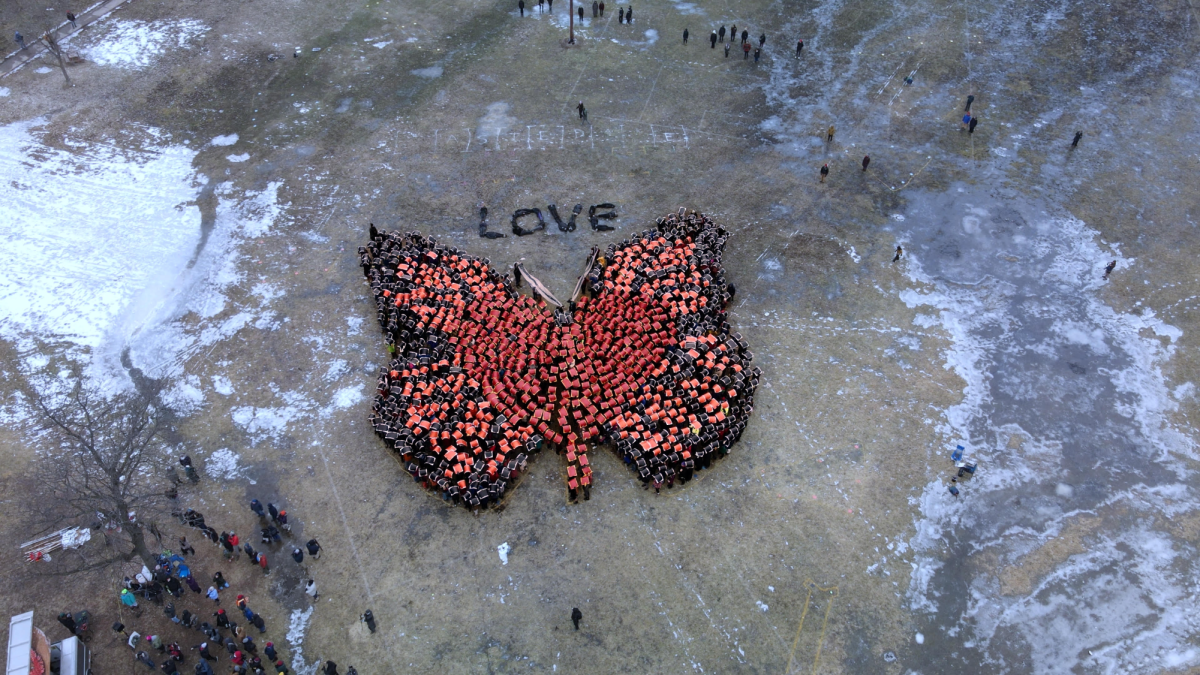
On the last day of February, it felt like nine degrees outside. Despite the cold, 1,000 people gathered at Powderhorn Park to form a monarch butterfly mosaic as a symbol of resistance against the actions of federal agents in Minnesota. Children stomped on the ice-frozen grass, and the sectioned-off groups huddled close, awaiting artistic direction.
I stopped by to see a friend, nestled in her assigned group with a red poster, ready to march into butterfly formation. She said the group was made up mostly of middle-aged women.
That’s one thing that needs to be honored this Women’s History Month, and especially in the wake of Operation Metro Surge: Women show up. We show up grounded in ways that suit us and serve the greater community.
“Women have a very long history of defending democracy around the world,” public affairs professor Christina Ewig said, moderator of a March 3 panel at the Humphrey School of Public Affairs.
The Defending Democracy: A Conversation with Minnesota Women Leaders panel featured Minnesota Solicitor General Liz Kramer and Unidos MN executive director Emilia González Avalos as panelists.
“If we think back to the democratization wave of [the] 1980s and 1990s in Eastern Europe and Latin America, women were at the forefront of those democracy movements,” Ewig said. “Women were leaders in African anti-colonial struggles and peacemakers at the end of many different African civil wars in the 2000s.”
In the 1980s, the Chilean women’s movement promoted the idea of “democracy in the country, democracy in the home,” linking authoritarianism on the streets to abuse within households, particularly under the regime of General Augusto Pinochet, Ewig added.
“As individuals that have often experienced discrimination in the public sphere and violence in the private sphere because of their gender, women’s life experiences often lead them to identify personally with the importance of the liberties promised by democracy,” Ewig said.
Kramer and González Avalos are Minneapolis leaders who staunchly defend our democratic rights in the courts and in civil society, respectively.
“Women are both the heroes and villains,” Kramer said during the panel. “It’s important to remember women are not a monolith in this country in terms of how they think or what they want to do with their time and their policy agenda.”
González Avalos said, a couple of decades ago, civil organization was often done by men and often only in private. But her vision, especially with Monarca, is of a community of everyday people who strengthen the role of a civil society. Part of that, she said, is to build an economy of love where love becomes public.
“It’s not just something that gets to happen in the private,” she said during the panel.
I got to witness these women as defenders of their communities, and I was also able to witness women as defenders of themselves.
At Broken Clock Brewing Cooperative, March 7, 20 women, myself included, gathered for a free self-defense class, held annually in honor of International Women’s Day. Women of all ages showed up — friends, mothers and daughters, and strangers. One of our first lessons, after serious encouragement to always arm ourselves with triple-action mace, was to use our voice.
There was no space for being polite, the instructors said. “Stop!” we yelled as the facilitators pretended to be aggressors approaching on the street. We had to practice being loud, alert and assertive — not easy targets. For some of us, this attitude was unfamiliar; there were many I’m-uncomfortable-so-I’m-smiling expressions.
But throughout the hour, we learned the basics of eye-poking, striking, kicking and how to maneuver out of a wrist hold. Ultimately, we were taught that we had the right to assert our space and defend ourselves if need be. We practiced fierceness because some situations necessitate it. We also laughed, because joy is often amplified in community.
On March 8, I met with 40 other women at an Uptown mansion at Lake of the Isles for a friendship speed-dating event. In contrast to self-defense, this pink-themed gathering encouraged an openness to new experiences and sparked a connection with a stranger. Over mini-games, charcuterie and small talk, many women left with a potential new friendship and a deeper connection to the women of Minneapolis.
Athena Papagiannopoulos, a longtime Minneapolis organizer, created Her Social Season as a way of bringing women of all ages together through intentionally curated events.
“I really do think that if more women had more friends, they just have better connection in general, just a better community, just a better system,” Papagiannopoulos said. “This is for all women.”
Her Social Season is a newer project for Papagiannopoulos, and one of her main motivators was the use of joy and connection as antidotes to political oppression.
“With us being under a second occupation, everyone is reacting to what’s happening, and that’s good, right?” Papagiannopoulos said. “We need community aid, but we also need to make space for joy, and I feel like it’s so easy for us to lose that.”
Papagiannopoulos also spoke of burnout as a community organizer, feeling the pressure to continuously fight the fight, to defend, to resist.
“I kept putting off joy,” Papagiannopoulos said. “If we don’t take the time to center that, it will just never be there. I want to fight against everything we’re doing while still centering joy.”
In defense of democracy, or of the self, for the sake of forming new friendships or a giant butterfly, Minneapolis women know what it means to show up. The nurturing of community is for the benefit of all.