


Holding vegetables in one hand and the strawberries in the other, University of Minnesota fourth-year Taesun Conners struggles to decide between food items as getting both could set her food budget back. Like many college students nationwide, Connors faces food insecurity — a challenge that remains largely invisible.
Food insecurity is a multifaceted problem driven by economic hardships, limited transportation, lack of affordable housing, and strict assistance eligibility. Beyond the Supplemental Nutrition Assistance Program, students rely on a patchwork of campus services like Nutritious U, community initiatives, and peer support to meet their basic needs.
In an email statement released to the MN Daily, the Minnesota Department of Children, Youth and Families said that students who lack consistent access to nutritious meals “lose their ability to concentrate, retain information, and perform well in their studies.” The department added that SNAP supports the “long-term economic mobility and strengthening of Minnesota’s future workforce.”
Recent data released from the 2019-2020 National Postsecondary Student Aid Study, the first nationally representative data on college student food insecurity, reveals that over 4 million students nationwide are experiencing food insecurity. Twenty-three percent of undergraduate students and 12% of graduate students experience insecurity, according to the study.
Conners said food insecurity doesn’t get talked about often.
“Most of my friends are talking about which grocery stores to go to, often comparing prices and trying to figure out which is the cheapest option,” Conners said.
According to the 2024 USDA Food Security Report, about 47.4 million people in the U.S. lived in food-insecure households in 2023. This lack of reliable access to nutritious meals can lead to long-term consequences such as poor nutrition, elevated stress and a higher risk for developing chronic diseases.
The Stories Behind the Numbers
Conners shared her struggles with food insecurity on campus.
“Frankly, right now, I make less than rent, although I am very fortunate to have a family that can help me with that; there are times where I am freaking out over what to buy,” Conners said.
She often sacrifices quality and taste for affordability, caught in a constant tug-of-war between budget constraints and nutrition.
“More often than not, places on campus aren’t the cheapest option because they inflate their prices, especially at stores like Target or Fresh Thyme, partly due to security staff,” Conners said.
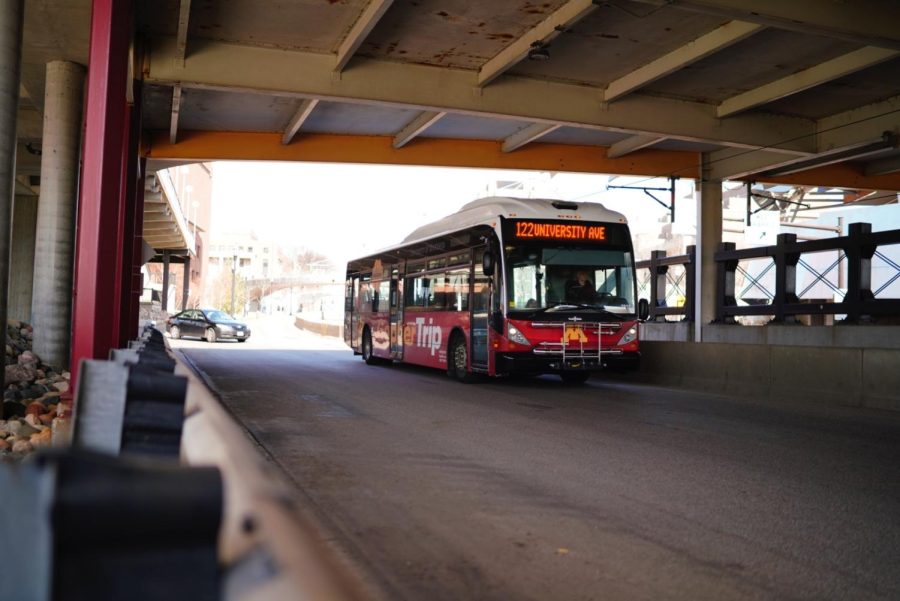
Without a car, transportation to affordable grocery stores can be a hurdle. When navigating snowy sidewalks and taking public transit, students like Connors have to be creative to find affordable food.
“I wish a lot more was being done about transport,” Conners said. “I can take the light rail, but often the light rail isn’t that safe to transport shopping goods, and I’m worried that they will get stolen.”
Conners has heard troubling Safe-U alerts about unsuspecting victims held at gunpoint for their groceries, instances that heighten her fears.
The last recorded Safe-U alert involving a grocery robbery was Oct. 21 of last year, according to the University Department of Public Safety website.
Food insecurity also affects social life. Students like Conners often have to compromise participation in activities in order to save money on food.
“Sometimes I have to limit the amount of times I hang out with friends, especially if it involves outings with money, like going to a restaurant,” she said.
Challenges with SNAP Enrollment
The Supplemental Nutrition Assistance Program helps low-income families and students to put food on their tables. SNAP benefits are loaded onto Electronic Benefits Transfer cards, which can be used like debit cards at most grocery stores, retailers and farmer markets that accept EBT.
For many, these benefits bridge the gap between what people can afford and what they need for a healthy diet.
However, qualifying for SNAP can be difficult for students.
Beyond income limits, students must meet extra criteria, like working at least 20 hours per week or being a full-time single parent. These limitations make it difficult for low-income students who don’t meet these requirements to gain access to basic needs.
As of December 2024, over 3,000 Minnesota college students were enrolled in SNAP, according to the Minnesota Department of Children, Youth, and Families. Of those students, 680 resided in Hennepin County, home to the University.
Campus Initiatives to Combat Food Insecurity
To bridge gaps in support, UMN’s Nutritious U program provides food pantries to students in need. Established in 2017, Nutritious U is run by Boynton Health, and offers a wide variety of fresh fruits, vegetables, canned goods, meats, milk and other culturally appropriate items.
Boynton Health Public Health director Michelle Trumpy said approximately 14,277 students were served this past school year.
“We know that students who are visiting the pantry are struggling with their food,” Trumpy said. “They are worried about getting enough food to eat, and we know that when they come to us, they are feeling less stress and generally getting enough good food to eat during the month that they visit.”
Sixty percent of Nutritious U’s visitors are international students, according to Trumpy. She said this is mainly because international students do not qualify for SNAP or other food assistance programs.
Challenges for Nutritious U, like funding limitations restricting pantry hours and access to certain areas on campus, remain. Yet, Trumpy said campus-based nutrition services play a critical role in reducing student stress and improving academic access.
Trends
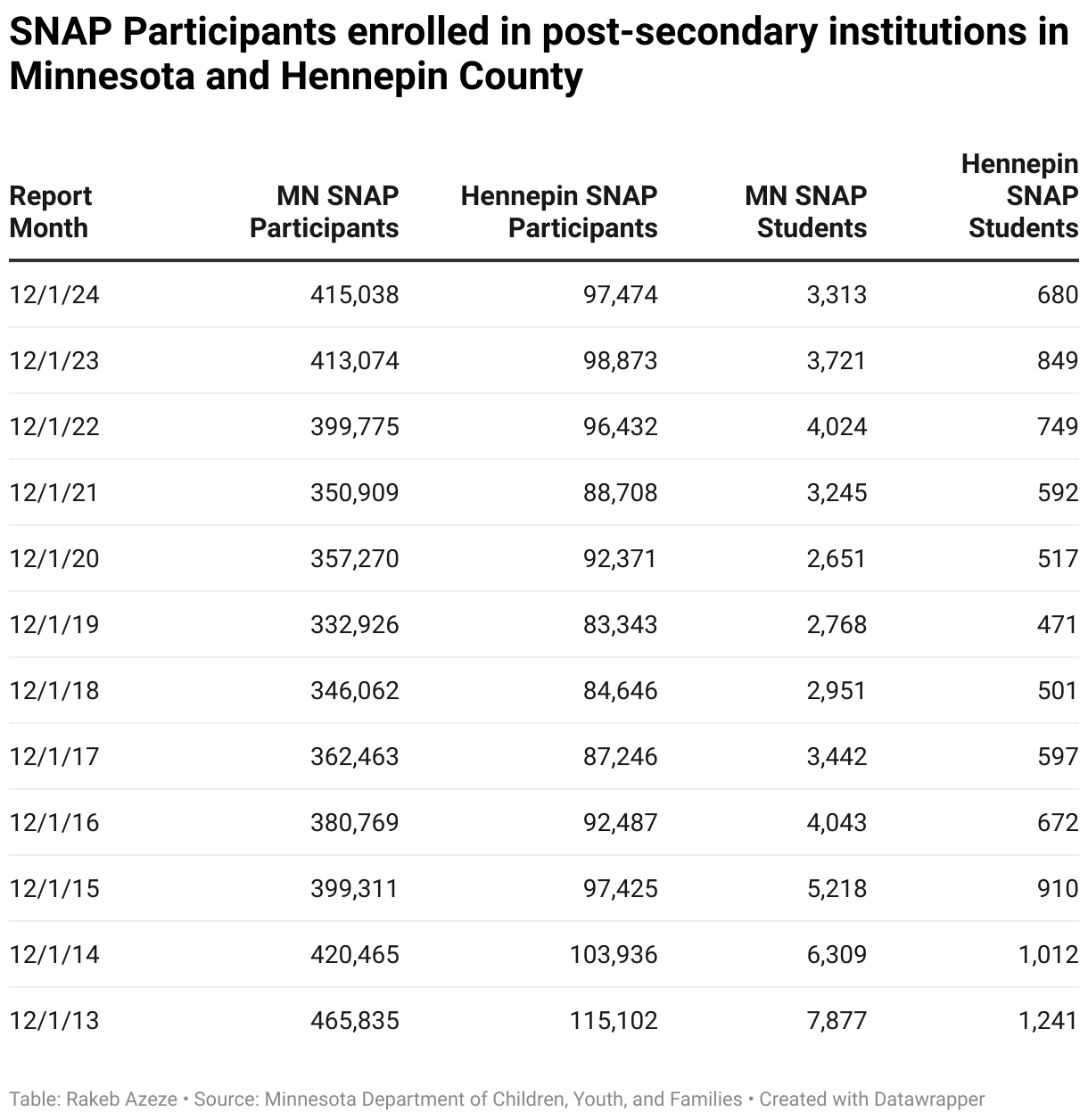
Despite SNAP’s benefits, enrollment among Minnesota students has declined by over 4,500 between 2013 and 2024. In Hennepin County alone, the number of students on SNAP almost halved from 1,241 in 2013 to only 680 in 2024.
Though enrollment has dropped, a significant number of students continue to face food insecurity. According to the 2024 Boynton College Health Survey, 21.8% of UMN Twin Cities students reported worrying about running out of food, with 12.4% of those experiencing food shortages without funds to buy more.
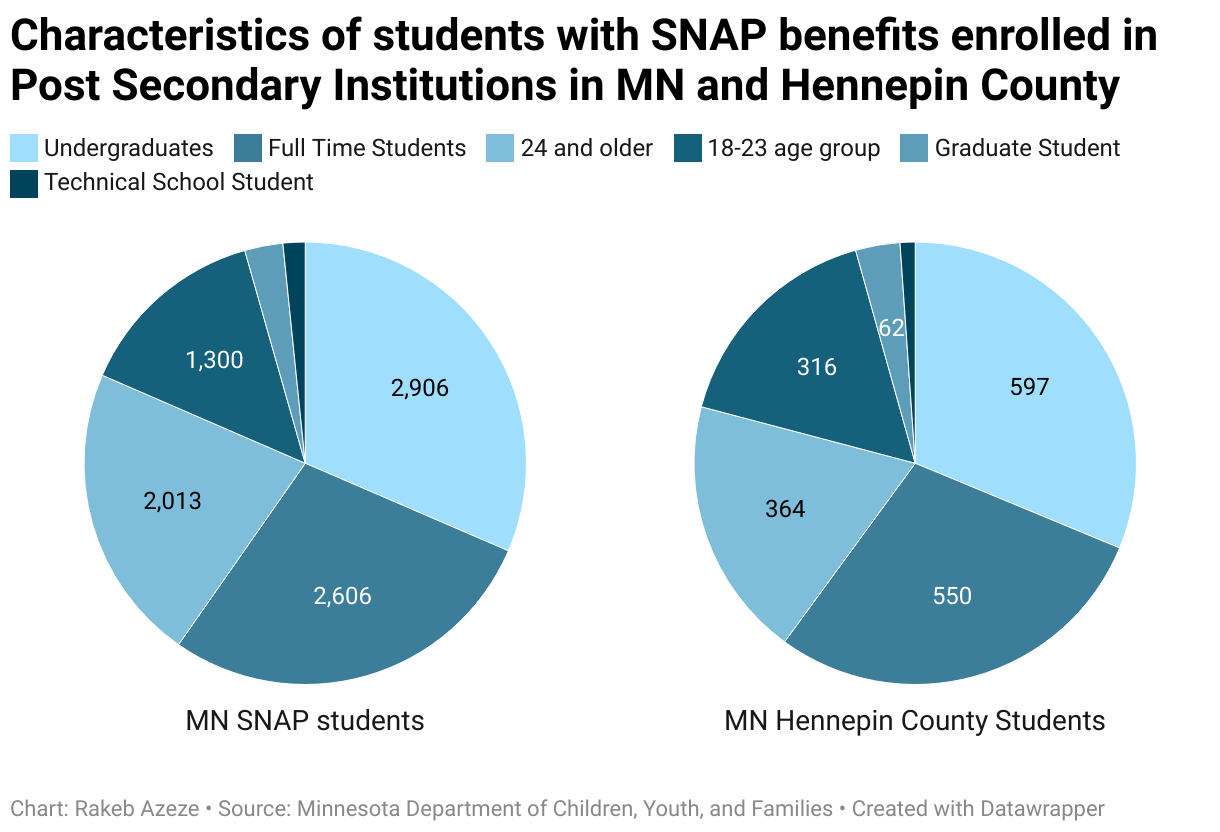
The majority of SNAP recipients among students are undergraduates, with 597 on SNAP in Hennepin County and 2,906 statewide. Graduate students account for a smaller portion, with 258 in Minnesota and 62 in Hennepin County enrolled in SNAP.
Both younger (ages 18-23) and older students (24 and above) participate, with older students representing a slightly larger share statewide.
Over 500 students receiving SNAP benefits are full-time students, indicating that even those enrolled full-time face financial barriers to adequate nutrition.
Awareness and Advocacy
In addition to the barrier of strict selection criteria, awareness of programs like SNAP and Nutritious U remains limited at the University.
Janani, who preferred not to share her last name for safety concerns, is a recent international University graduate who said there was a lack of information on campus.
“Not a lot of people know about programs like Nutritious U,” Janani said. “I found out about it late in my sophomore year, and until then, I didn’t know it was a thing.”
Before discovering the pantry, Janani said she used her part-time job income to afford groceries. She said there is an emphatic need for better University outreach to inform students about the opportunities available to them.
“If I were the University, I would try to market those things more and make an advisory committee where students who need to talk to someone about their struggles to make ends meet can do so,” Janani said.
A Complex Problem and Hope for Change
The University of Minnesota is addressing these challenges by requesting $1.5 million for basic needs resources in the 2026-2027 biennial state budget. This funding aims to combat food insecurity by increasing food pantry hours, hiring additional staff to assist students navigating assistance programs and providing short-term emergency grants.
For students like Conners and Janani, these efforts can’t come soon enough. Facing tough choices every month between fresh produce and basic staples, they embody the reality behind the statistics.
“At the end of the day, we are here to study, so basic needs like food shouldn’t be a worry,” Janani said.
Students experiencing food insecurity or who want to know more about Nutrious U can visit their webpage.





Zion
Aug 28, 2025 at 6:25 pm
Beautlifully written story! This unfortunately displays the reality most students and residents are living in. Thank you for reporting on this important issue!
JW
Aug 25, 2025 at 10:52 am
Please stop with the “food insecurity” BS. When I was in college I lived on ramen for 4 years. It’s no big deal. You simply cannot tell me that there is anyone at the U that is truly food insecure – they may be making choices to spend their money on something else but those are choices.