Feb. 17 marked the beginning of a new year on the lunisolar calendar. Lunar New Year is a global celebration of the arrival of spring; while it is a major holiday in China, it is widely celebrated across Asia in Vietnam, Singapore, Indonesia and other countries with a significant Chinese population.
The holiday is brought to life through food, art, dance, music and traditions carried through generations. Central to these customs is the Chinese zodiac, with 2026 honoring the year of the horse.
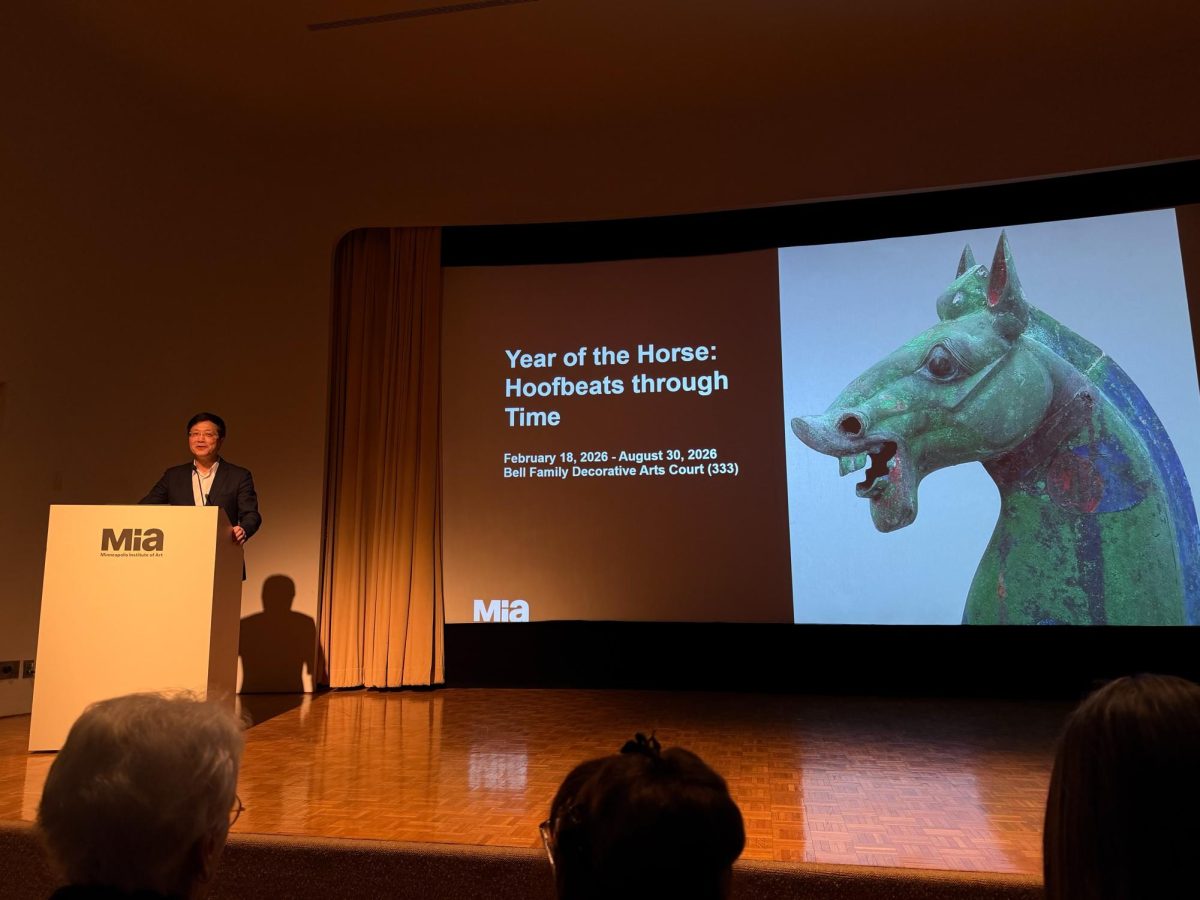
The celebration has extended to the Twin Cities as the Minneapolis Institute of Art has unveiled a dedicated exhibition: “Year of the Horse: Hoofbeats Through Time.” The collection, which runs through Aug. 30, explores the animals’ legacy across centuries of art, history and Chinese culture.
On Thursday evening, Liu Yang, Mia’s chair of Asian art and curator of Chinese art, welcomed guests to the museum’s Pillsbury Auditorium for a special lecture. The evening offered an intimate look into the newly opened exhibition, highlighting some of its most striking pieces and providing a scholarly lens to the collection’s historical significance.
During the presentation, Yang said the exhibition explores the horse as both a physical creature and a cultural figure; one that “embodies strength, status, virtue and aspiration.” The 70 items on display were carefully selected from a collection of more than 7,000 objects in the museum’s Asian collection, marking Mia as one of the largest collectors of Asian work in the nation.
Broken into 10 thematic sections, the exhibition features bronzes, ceramics, jades, paintings, textiles and more spanning more than 3,000 years from the 12th century B.C. to the contemporary period.
‘Horse as Sacred Medium and Martial Power’
Spanning back to the Bronze Age, China’s early history established the horse as a spiritual symbol of elite strength. Yang shared how horses were believed to serve as a link between the human world and the spiritual realm. They were often sacrificed and buried alongside chariots near royal tombs to serve the deceased in the afterlife and as an offering to the gods.

The exhibition features bronze or jade bridle connectors once used on those chariots, some depicting cicadas, a human face and other animals. Each depiction represents a unique ideological layer of the period.
“It’s very often in the Bronze Age from that period you see that the cicada is decorated too,” Yang said. “As you all know, the life of a cicada changes in a different cycle. So that gives the idea of perhaps a longevity of life.”
‘Horse as Symbol of Status and Procession’
Starting in the Han dynasty, Yang shares how the horse became a symbol of power and social order. Art from this period reflects this shift, displaying horses in large ceremonial processions linked to the nobles they served.
“Their [horses] presence signals wealth and power,” Yang said. “Horse figures placed in tombs reinforce this meaning. They were meant to accompany elite individuals into the afterlife, continuing to serve them just as they had in life.”
‘Horse as Zodiac Animal’
One of the most beloved sections focuses on the horse as a zodiac animal. As the seventh sign in the lunar calendar, the horse is connected to the earthly branch representing the peak of the summer and the height of the sun’s energy. Those born under this sign are said to be high-energy, confident and intellectually lively.
Yang highlighted a centerpiece of the collection from the Southern Song dynasty, 1127 – 1279, a stoneware funeral jar. The jar, meant to hold ashes, is intricately decorated with four deities on top representing the cardinal directions and the 12 zodiac figures encircle the jar’s body.
“If you go to the exhibition, you can work out what animal is [the] horse,” Yang said with a laugh, as the audience joined in the amusement. “Good luck if you can find it – I had difficulty finding it.”
‘Horse as Mirror of Shifting Worlds’
Horse as a mirror of shifting worlds connects closely to the contemporary period. The most notable artwork in this section is Yang Yongliang’s Herding Horses, a photographic collage that explores the difficulty of translating traditional ideals into a modern society.
Yang said while the expansive piece resembles an authentic, traditional landscape from a distance, a closer look reveals a more harrowing reality. The scenery is composed of more modern elements, such as a long destroyed car sitting amidst the rubble of a desolate landscape.
There is more to explore within this exciting new exhibition, located in the Bell Family Decorative Arts Court on the museum’s third floor. Open to the public free of charge, The Mia invites guests to experience the collection first-hand throughout its six-month residency, which runs through late August.