


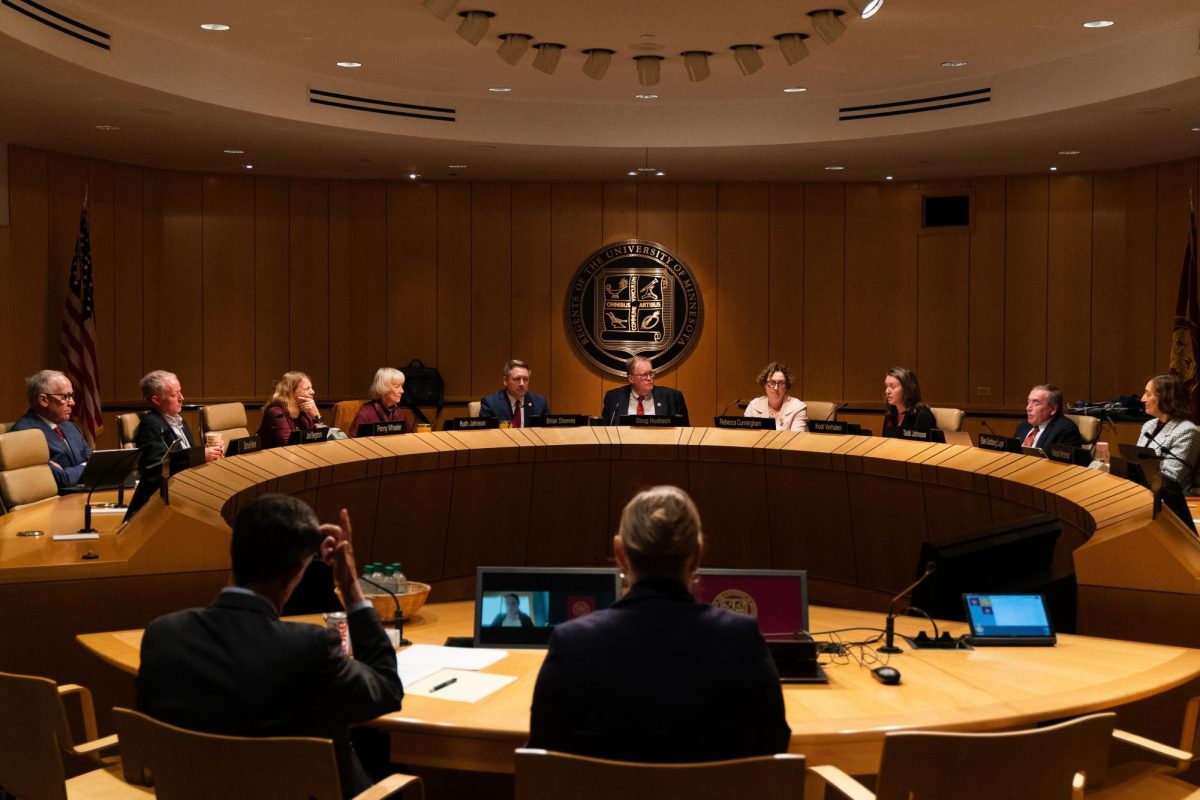
During the University of Minnesota’s monthly Board of Regents meeting on Feb. 3, student demonstrators packed the room to protest mass student arrests, University police aggression and limited learning accommodations under a bigger looming controversy of University impartiality.
Graduate Labor Union President Ben Lewis interjected at the start of the meeting, calling on the regents at the round table to address the demands made by numerous University groups and unions such as the Graduate Labor Union, American Federation of State, County and Municipal Employees and Students for a Democratic Society.
“There’s been a lot of encouraging news that’s come out over the last couple days, but we still don’t necessarily believe–,” Lewis said before he was interrupted.
Chair Board and Regent Doug Huebsch interrupted Lewis and banged his gavel 11 times total, attempting to drown out the counterspeech. The meeting, livestreamed on screens surrounding the boardroom, flashed a cautionary message on a white screen censoring the interruption:
“Please be quiet and allow this meeting to continue,” the screen read. “The University honors free speech and the expression rights of our community members. However, demonstrations or disruptive behavior are not permitted at this meeting and are a violation of University Policy and Minnesota State Law. You are welcome to stay if you remain quiet and refrain from further disruption.”
A second objector, Emma Daugherty-Leiter, arose and walked to the front of the room, confronting the masses at the roundtable.
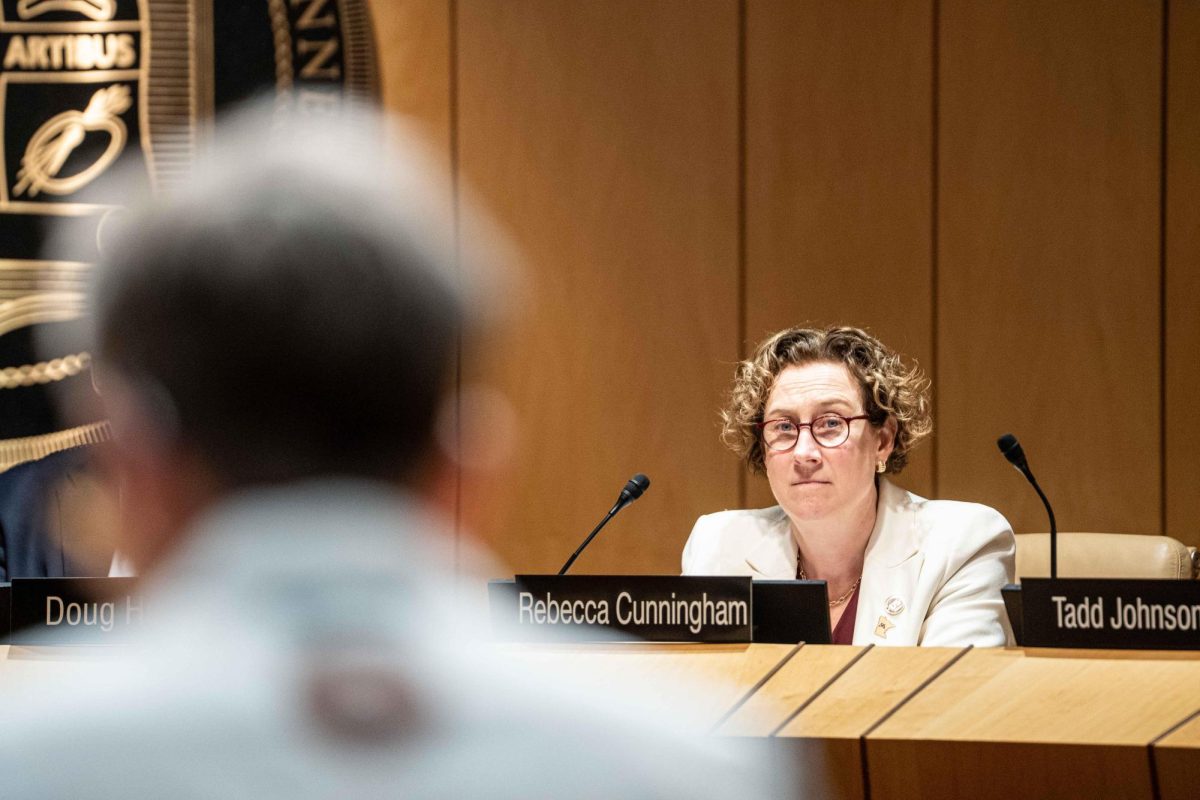
“Rebecca Cunningham!” Daugherty-Leiter said. “Students for a Democratic Society supports the GLU to protect the U with our own set of demands.”
Again, Huebsch fought the noise by pounding the gavel. Cunningham left the table, escorted by University Police.
Regent James Farnsworth, present at the meeting, raised a common solution to meeting disruptions — they would not occur if community members were given a designated chance to speak.
Formal public comment periods are typically used by governmental bodies and other University leadership boards to allow open discussion. The approach is something Farnsworth has been working toward for the last 4.5 years to get implemented since being appointed to the Board.
“I think, when you don’t have a formal public comment period, and you don’t have a formal, regular, transparent, publicly available way for people to have their voices heard, you create a situation where there’s meeting disruptions consistently,” Farnsworth said. “I think we saw that again on Friday.”
Currently, the only way for people to voice their University concerns is through the Board’s virtual portal.
You can leave a text, video or audio comment, or request to address the board in person — but only the Board’s leadership gets to decide whether or not the request is granted, Farnsworth said. The rest of the Board is informed after the fact, once the meeting has already begun.
When the meeting resumed again, Huebsch called upon Bergstrom to elaborate on personal views he disclosed in the Board’s last meeting, in which he called for a moment of silence to honor the late Alex Pretti, a University alum shot and killed by federal agents. Struggling through words, Bergstrom said he hoped that the headlines about an end to Operation Metro Surge were true.
He likened the “ICE Out” movement to Minnesotans’ exchange of winter with summer by referencing a passage from the Book of Ecclesiastes, part of the Bible: how every season has a purpose under heaven.
“Now, historically, ice out was a bittersweet moment for those of us who enjoyed and embraced our winter. We will soon get to exchange our skates, skis and sleds for garden implements and boats,” Bergstrom said. “But though the seasons will change, the impacts of the last two months will have lingering effects.”
When a third and final protester uttered profanity under a cough’s guise in response to Cunningham’s negation of campus ICE activity, police physically ousted the individual as he objected to their use of force down the hall.
Daugherty-Leiter said University police have taken on an air of violence in the last two months.
“They tend to be pretty overly aggressive, and at the graduate protests, they did fire into the crowd with pepper guns. My friend was hit directly in the face, and was bleeding from the face because they were shooting at people in the crowd,” Daugherty-Leiter said. “It’s crazy how militarized they are.”
Daugherty-Leiter said the real support is found within a community, not from the higher powers that be.
“And when it comes down to it, as you can see, the Board of Regents, the people up top, have not been helping us,” Daugherty-Leiter said. “You can see that those people are not going to save you. It’s your friends, your family, it’s your neighbors that are going to save you, it’s the students around you, it’s the faculty that are working together. Those people in high places have not made steps to save us.”





James
Feb 20, 2026 at 10:13 am
I find this amazing that these “students” pull this crap. This is not the way to handle things nor is it proper to treat the regents and our president this way, it will get you no where. I guess SDS stands for Stupid Dumb Students
Regents do not get paid
Feb 19, 2026 at 6:00 pm
President Cunningham and Regent Chair Huebsch are honorable people. The recent SDS display was disrespectful and will not serve them well. The Regents are working overtime to make themselves available for public comment; everything they do is “gratis.” No paycheck. Every Regent works tirelessly on behalf of the University, students, and all stakeholders. They deserve to be thanked and appreciated.
WTF
Feb 18, 2026 at 10:30 am
For the 30 plus years I taught at the U, shared governance was a central value and commitment to faculty, staff, students and administrators. With Cunningham, her administration, and Regents like Huebsch, it’s completely disappeared. WTF!
Jerry Cohen
Feb 17, 2026 at 11:45 am
” Cunningham left the table, escorted by University Police. ” A President who fears her students is no real President. Better to order donuts, sit in the atrium and ask them about their concerns. Running to police protection and leaving is not real leadership.
Marie
Feb 17, 2026 at 10:43 am
“Cunningham left the table, escorted by University Police.” She was not in danger, because if that had been the case they would have escorted all of the Regents out. Instead, Cunningham chose to leave rather than face the criticism brought on by her own lack of leadership.
Keya Ganguly
Feb 17, 2026 at 10:18 am
Cunningham is a disgrace. As is the Board of Regents for its heavy-handed way of dealing with students — protesters and otherwise. Someone needs to remind the U prez. and the BOR that students and faculty are the primary stakeholders.
Sue Spiegel Pastin, ‘68
Feb 17, 2026 at 10:04 am
There definitely should be a time for public comment at Regents meetings!
Shame on the Regents
Feb 17, 2026 at 6:18 am
Brave students! Especially Emma who looks very calm and determined in the face of a cop who clearly can’t wait to put hands on.
As pointed out in the article, by a Regent, no less, the Regents don’t want a public speaking period. Many years ago, they allowed for something like an hour of public input once a year but they ended that in the early or mid 2000s. Now you have to risk contact with the cops if you speak up. And the Regents always just watch it all go down, our undergrads taken away by UMPD and turned over to the court system, just for standing up for the truth.