

At a dinner party a couple weeks ago, I asked two economics graduate students how artificial intelligence works in their field. They said they use it mostly for coding and data interpretation — tasks that previously took time but are now expedited with language models.
I then turned to my fellow creative writing graduate students to ask: “Do you use AI?” I got a resounding “No!” No, because of the environmental and public health harm and the sense of infringed agency. AI will not write our poems.
University of Minnesota journalism senior lecturer Gayle Golden said students are often reluctant to integrate AI into their workflow, even as some of the field embraces the tool’s efficiency.
“I’m most struck with their reluctance to dive in, and I wasn’t seeing that before,” Golden said.
Golden values this hesitancy because it shows critical thinking, but this semester, especially, their resistance has grown.
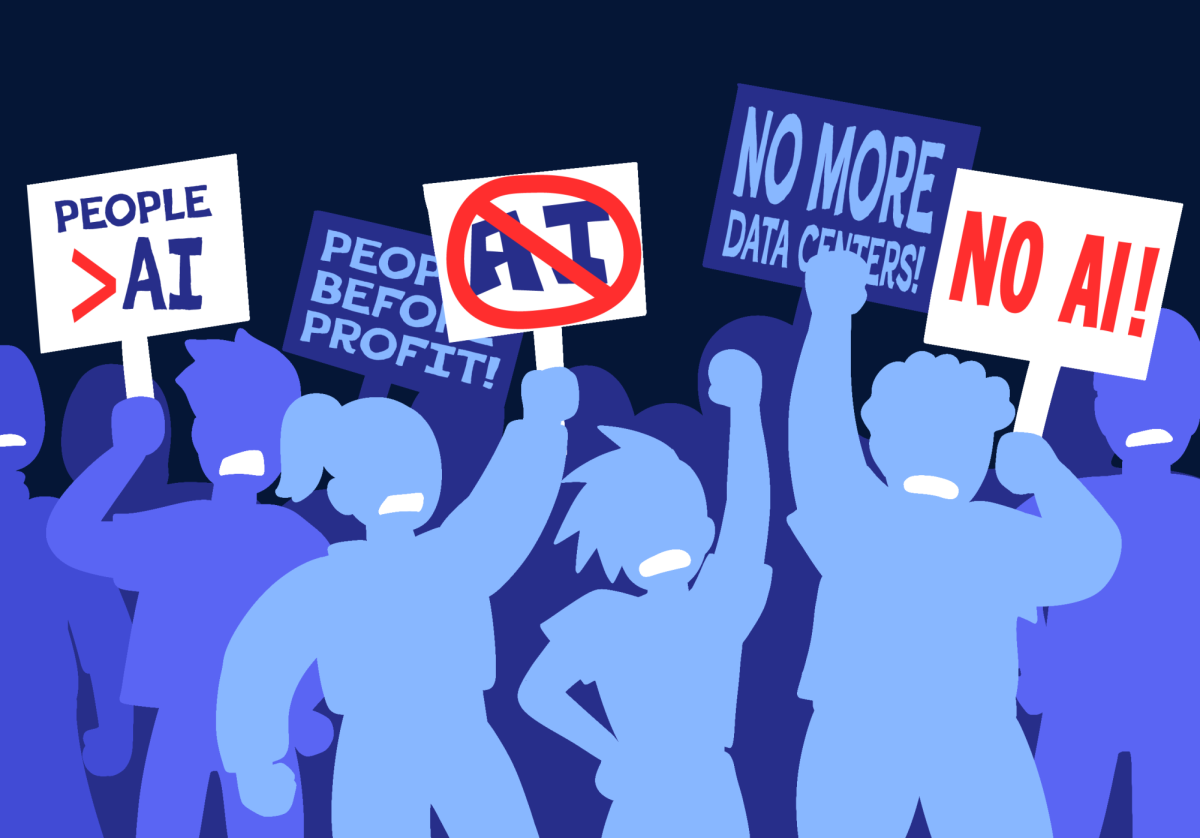
“You aren’t really gonna be able to make change in something if you don’t understand it, [if] you’re just gonna hold a sign on the outside of the data center,” Golden said. “You’re going to have to understand what this is, you’re going to have to have some proficiency. Otherwise, you’re gonna be irrelevant.”
This issue is deeper than just “AI Bad” or “AI Good.”
University biological science and physiology major Aaron Maust likened AI’s inevitability to that of computers. But the first-year student is also concerned with AI ethics in his field and the world.
“In life sciences fields, there’s a lot of ethics,” Maust said. “It’s the study of life, and AI, it’s not living. A lot of problems in the field are solved creatively in between people. AI, as a model, doesn’t care about that kind of thing. It’s a machine.”
AI can, however, be a helpful study tool, Maust said, who uses it to synthesize notes and then generate a personalized quiz. Time compression on data processes is one of AI’s biggest strengths, he added.
However, Maust also holds space for concerns.
“As far as maintaining integrity, I don’t know,” Maust said. “AI models are getting better at impersonating people, which is the concerning part.”
That, and the energy uses, job loss and impacts on local communities. AI affects everybody because it touches the environment, society, politics and economics, Maust said.
Still, he has hope that AI could be used to address these issues, but understands its limitations as an interpretive and predictive tool.
“People can lie, and so, AI can lie,” Maust said. “It’s not separate from people. It’s an extension of people.”
Postsecondary Enrollment Options student Ariya Tikoo, who is currently studying computer science at the University, said she hopes the field centers people as its workforce, despite AI’s job-replacing dilemma.
“I think it’s more a matter of reallocation,” Tikoo said. “I would hope that that’s what the industry looks like in 10 years. I think it’s kind of dumb to be cutting people right now, because then you’re just not efficiently using people and their skills and what they have to offer.”
Tikoo said her professors are usually explicit about where AI is acceptable and where it is not. You can use it to generate a prompt, but not write your lab.
“So people are able to think for themselves and generate their own work, but then at the same time, I think they’re aware that it can be a helpful tool,” Tikoo said.
Trade-offs are true with any innovation, Tikoo added. But she hopes people with moral compasses will become central to AI development in a way that leads the industry consciously, while also expanding minds. Balance is part of it, even if she doesn’t have all the answers.
I teach an introductory creative writing course, and it is strictly AI-free. There is something vital at work when writing fiction, poetry and nonfiction. It is a space to flex your creative muscle. The processes AI cuts out in other fields in the name of efficiency are exactly what the arts value.
“AI artists are not artists,” anthropology and English third-year student Tara Beaudry said. “As a creative, I do art, I write. I find [AI] takes away the humanity from being creative.”
Beaudry said if AI sticks around, there is no best-case scenario. It is replacing meaning and what is vital to being human.
“Meaning is being,” Beaudry said. “It’s taken away our ability to think. Our thoughts are who we are, in a way.”
A large consensus in my reporting has been that no one wants AI to replace human creativity and thought, not students nor faculty. But it does magnetize our imagination toward an AI-future.
In class last week, one of my peers’ creative essays challenged the viewpoint that AI is inevitable by enticing human imagination. Imagine a world where community and health were prioritized over productivity and profit. Imagine if all our ethical concerns around AI became central to the development and dissemination of this tool.
I wonder if we are in a window of opportunity, as we always are at the dawn of innovation. The University is a microcosm of the world, and if AI is truly as inevitable as dominant thought deems, this foundation, even here on campus, is integral to shaping the imagination of AI.





wow
Apr 12, 2026 at 8:16 am
We have already reached the point where you can measure a person’s intelligence, critical thinking skills and level of care and understanding about the health of the Earth simply by listening to them answer the question “Is AI good or bad?”