If there is one thing that has been on the minds of everyone in the technology sector, it’s artificial intelligence.
Since 2013, more than $1.6 trillion has been invested in AI technologies of various kinds. That’s $200 billion more than the current annual budget for the United States Department of Defense.
Around $375 billion of that sum was forecasted to be invested in 2025 alone, showing the recent investment spike as the public discourse about AI technologies got louder and louder.
This is truly an insane investment for a single field. With the incredible rate at which AI projects are being funded and the lofty predictions being espoused by those at the forefront of the growing AI industry, the question becomes whether all of this hype and investment is sustainable.
Alok Gupta, professor of information and decision sciences at the University of Minnesota’s Carlson School of Management, said the hype around AI could best be compared to the buzz around online shopping.
“When e-commerce hype happened, a lot of the specific initiatives and businesses that people started did not survive, but e-commerce in general thrived,” Gupta said. “We can’t live without our Amazon.”
AI has certainly made its mark on college life as well, with studies showing roughly 90% of college students in the U.S. have used AI academically.
First-year University student Caitlyn Bahe said she primarily uses AI to help with her comprehension of complicated readings or scholarly works full of jargon.

“I try not to use it as much,” Bahe said. “I use it as a tool, and not something to replace. I don’t want it to do all my work.”
First-year student Sophia Beckman said AI can help her in her learning process by proofreading work or helping break down complex course materials.
“It’s kind of like an extra boost to learning,” Beckman said. “I’m still learning, I still want to learn and gain the information. It just takes out two steps that were maybe a little unnecessary in the process of getting to what I was originally going to learn about.”
Given the widespread use of common AI tools like ChatGPT in colleges across the nation, we are left to wonder what would happen if access to these tools became more limited or disappeared entirely. If investment in current AI models isn’t sustained, fears about an AI bubble bursting may be realized.
While that may seem far-fetched, the burst of the AI bubble is closer than you think, as companies at the forefront of the industry currently face financial challenges.
Top AI developers like Amazon, Microsoft, Nvidia, Meta, Google and Oracle lost more than $1 trillion in their estimated worth at the start of February, while experts warn that ChatGPT’s owner OpenAI could soon run out of money.
After all, OpenAI and its founder plan to burn through $17 billion in 2026 and spend $1 trillion in infrastructure investments, a sum that even promised investments by companies like Nvidia would struggle to keep up with.
Financial analysis predicts OpenAI’s revenue will still not outpace its expenses by 2030, painting a bleak picture for the future of the industry powerhouse. While we can’t predict what that would mean for AI tools like ChatGPT, it wouldn’t be unreasonable to expect access to decrease.
Bahe said because her dad introduced her to AI at the start of its emergence, she is accustomed to using it to assist her learning — and, as such, she would be impacted if common AI tools became unavailable.
“It wouldn’t really impact my learning, but it would impact how difficult it is to obtain information and understand it,” Bahe said.
Beckman said losing AI tools could affect her time management, due to a loss of learning convenience.
“If I have to put an extra hour or so into really diving deep into every single thing something says, that’ll lose me time for working on another class,” Beckman said.
It should be noted that AI as a whole isn’t going away anytime soon. The innovations of the past decade will not live and die with the biggest AI companies.
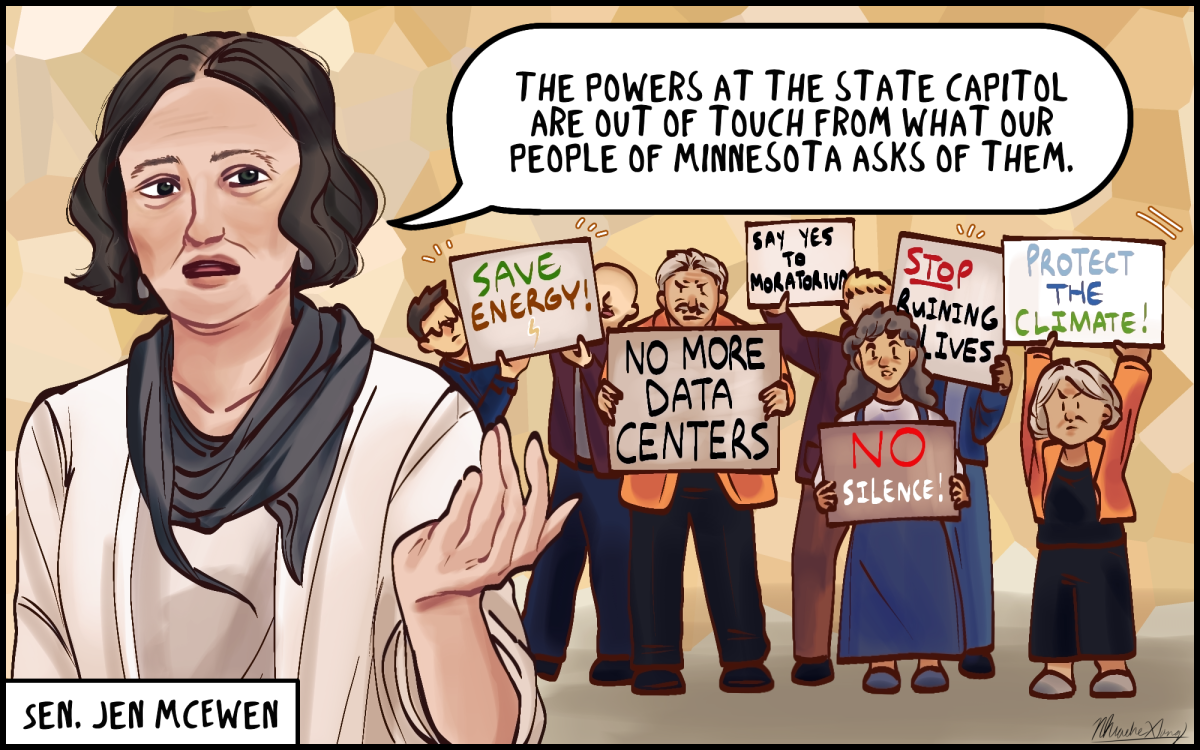
Gupta said even if the economic methods are sustainable, the resource cost of expanding data centers to feed larger models poses concerns about environmental stability. Instead, many AI tasks can be done with more targeted AI models.
“For most people, what they need is not these largest models that are produced with the goal of artificial general intelligence,” Gupta said. “For most tasks, you can build a smaller model that is just as good.”
Like with all technological innovations, AI will impact our lives beyond what models like ChatGPT or Microsoft Copilot can do.
Gupta added that while the AI bubble may have negative implications for those invested in companies that push large AI models, many companies will be able to pivot to smaller, more specific models. He added this will save consumers from feeling all the effects.
“People who are invested in these companies, they might have significant challenges,” Gupta said. “But I don’t think that that’ll be the end of AI companies, or that users of these companies will face massive challenges.”
No matter if you love it or hate it, the fact is AI has changed how we approach tasks in our daily lives, whether for work, school or creative uses.
But as the hype train reaches its final stop, we must be willing and able to rethink how we use AI models in order to best adapt to our post-bubble digital world.