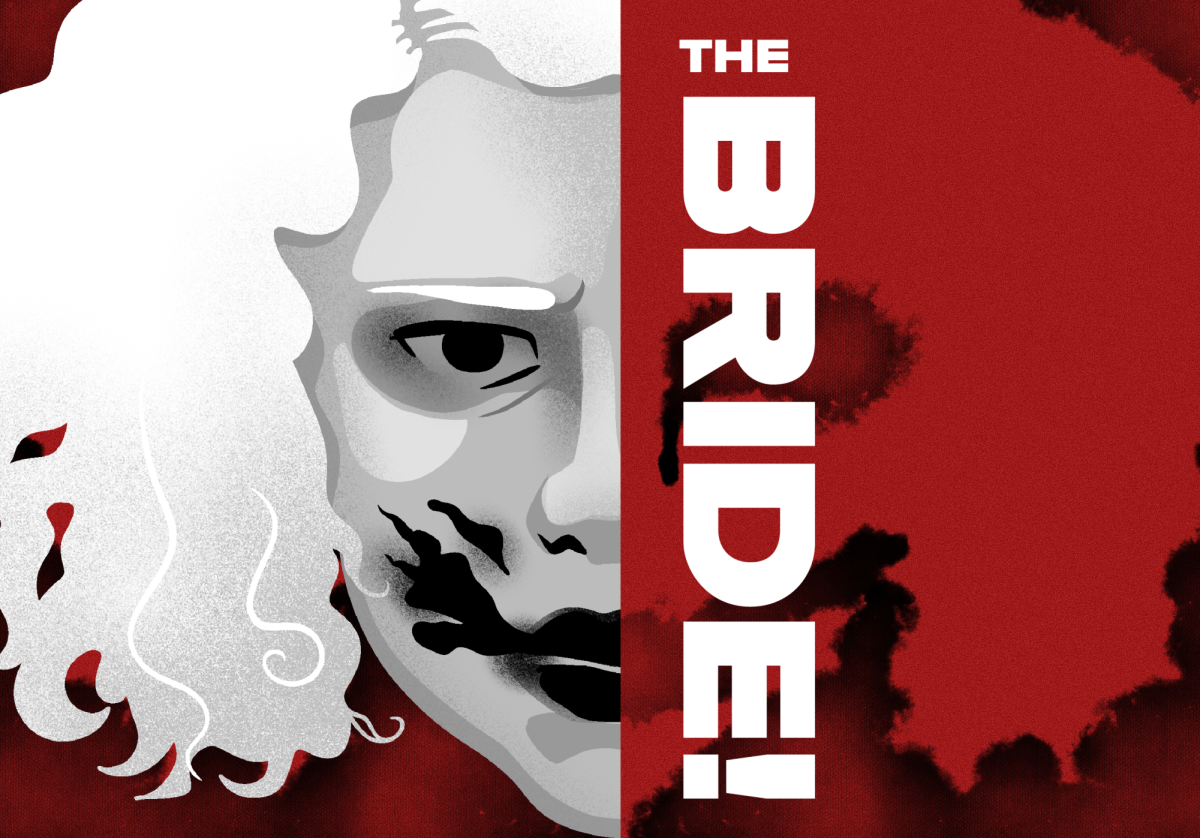
Director Maggie Gyllenhaal debuts her second feature film in 2026, ‘The Bride!’, a striking feminist romantic horror starring Academy Award winners Christian Bale and Jessie Buckley.
Anticipation for the film was palpable, driven by its gaudy, gothic reimagining of ‘Frankenstein’ and casting of the newly Oscar-winning Buckley. Both audiences and I were eager to see a daring interpretation through the emotional range Buckley and Bale have displayed throughout their filmographies.
In a February interview with Deadline, Gyllenhaal shared the intention behind the film, noting that a major precipice of ‘The Bride!’ is the exploration of consent. Specifically, she examines how the mythology of Frankenstein’s bride has historically stripped the character of all autonomy and agency.
While Gyllenhaal understands Frankenstein’s loneliness and desire for companionship, she asks the pivotal question: “What about her?”
“I understand Frankenstein’s ask; he’s this very lonely, vulnerable man who is literally at a life-and-death degree of loneliness, saying, ‘Please, help me find someone to be with,’ but–what about her? I mean, what about her?” Gyllenhaal said.
This question of agency fuels the film’s big swings through a fast-paced narrative, multiple subplots and visually striking, campy costuming. While the central messaging is clear, the sheer volume of narratives and thematic threads ultimately crowds the film’s platform for its core theme.
In many feminist horror films, the plot will explore how a woman’s internal feelings manifest — often gruesomely — when she is pushed to the brink by a society aiming to control or focus on her body while suppressing her voice and mind.
Gyllenhaal uses this trope to explore the complexity of women’s responses to abuse, assault and suppression. Ida, played by Buckley, is transformed into the bride following her death at the hands of the Chicago mob and carries the weight of the abuse she experienced and witnessed. Furthermore, she carries the voice of “Frankenstein” author Mary Shelley, whose spirit inhabits Ida’s body.

Buckley is arguably the film’s greatest asset, successfully portraying a character who must navigate two distinct voices. Her rebellion against the patriarchal society of 1930s Chicago serves as a pursuit of justice for herself, Shelley and all women.
However, despite a cast that pushes for such an impactful portrayal, the actors are evidently held back by a script built upon on-the-nose dialogue that tells the audience what to think rather than allowing them to reach their own interpretations.
The dialogue is not the only element subject to heavy-handedness. The film experiences stark tonal shifts with its spectacle trumping substance.
A moment that proves both entertaining and confusing comes in the second act: a breakout musical number to ‘Puttin’ on the Ritz.’ After Ida and Frank sneak into an exclusive dinner party to steal food, the room erupts into a chaotic, trance-like dance.
This sequence serves as a direct link to Frank’s admiration for cinema, specifically to his idolization of fictional movie star Ronnie Reed, played by Jake Gyllenhaal. Frank credits Ronnie with saving his life, noting that the actor’s films made him feel less alone in his societal isolation and eventually provided a point of emotional connection with Ida.
While the breakout number was a spectacle to watch, I found myself asking, how does this subplot serve Gyllenhaal’s central theme of female autonomy?
Although a viewer could conjure a handful of thematic connections, the film falls short when attempting to deepen the narrative threads necessary to make the musical detour feel meaningful.
This heavy-handedness is further congested by various subplots involving Dr. Cornelia Euphronious, detectives Jake Wiles and Myrna Malloy, “Frank” Frankenstein, the Chicago mob and a movement later sparked by the bride. While these competing elements are individually interesting, they are hardly given the space to truly drive home their impact on the central theme.
Ultimately, with its fragmented storylines, “The Bride!” is a film that may not be easily grasped in all its nuances upon a first watch. Its complexity, paired with a crowded narrative, tarnishes the likelihood of a rewatch. While the film is high energy, its momentum is underwhelmingly plateaued, leaving viewers with mediocrity despite its eye-catching buzz.