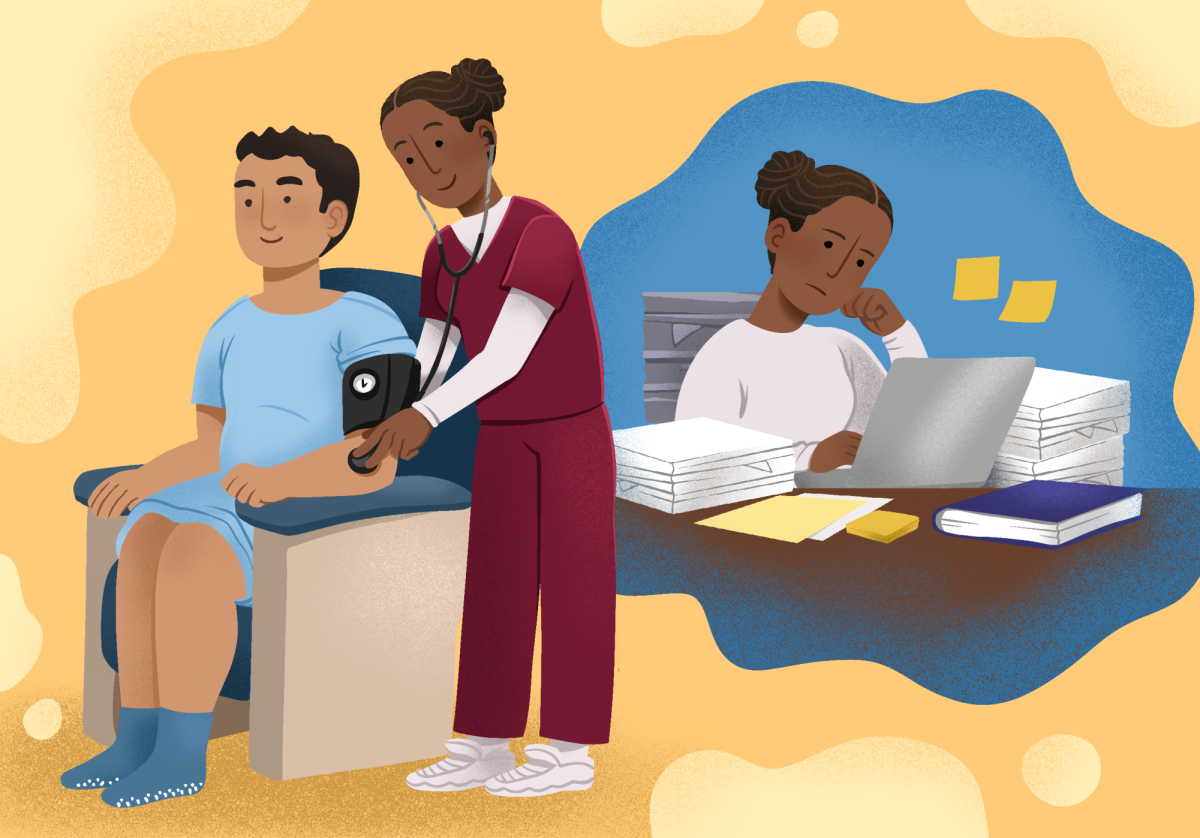
Some of the most passionate and hardworking students I know aspire to pursue careers in nursing. I have always appreciated the dedication nurses have, but talking to a close friend about her nursing school experience was the first time I realized just how passionate they are.
The way her face lit up while talking about spending long nights working in a pediatric unit, and the fact that she could balance a social life, school work and clinicals and still come out of it all with pure enthusiasm for her work, gave me a pretty good sense of the type of people who choose to go into nursing.
Director of the University of Minnesota School of Nursing’s Office of Student and Career Advancement Services, Kathryn Schwartz, said the nursing program has students who are wonderful to work with.
“They come to a problem with the desire to help and make it better, but also the skill set to really bring value and a different lens into how we might solve those problems,” Schwartz said. “So I think that that’s a beautiful way to go through the world, but also to contribute to the campus community.”
The U.S. Department of Education recently proposed redefining which programs are considered professional degrees. Notably excluded from this new definition are graduate nursing programs.
If approved and implemented next year, students pursuing further education in nursing would be eligible for less financial support for graduate programs. These programs are already incredibly expensive.
While not every student pursuing a bachelor’s degree in nursing may want to continue schooling, those looking to become advanced practice nurses or further their education in other ways could face a harder path.
A loss of funding could also discourage prospective nursing students from pursuing their education altogether, which would be bad news for a field that is already desperately looking for more people.
University School of Nursing Dean Connie Delaney said some hospitals don’t have beds open due to low staffing.
“We have the most dire shortage going on in literally every state, every care environment,” Delaney said.
The Education Department recognized that professional programs are ones that lead to licensure and practice, which nursing certainly does. But their actions don’t match their words.
Beyond monetary limitations, the decision symbolizes a clear disregard for a population of healthcare professionals who have already fought so hard against bias related to their careers.
Registered nurses comprise the largest healthcare occupation, and the profession is dominated by women. The message the department is relaying echoes the sexist sentiment that predominantly female workforces are less worthy of respect.
The rigor of nursing programs, especially at the University, is exhaustive.
“The program’s intense, it’s highly ranked,” Delaney said. “It has everything from classroom to laboratory and simulation to essential clinical experience and actual people’s lives within very complex health systems and in complex communities.”
The reality is that without nursing, the healthcare system would crumble.
“Nurses, in how they work with patients and families, literally have the pulse on that individual family 24/7,” Delaney said.
Delaney added that the commitment, knowledge and skill inherent to nursing are just some of the factors that make nursing vital to the whole healthcare system.
“Nursing, by the public, is rated as the most trusted profession, and there’s a reason for that,” Delaney said. “Because we keep the patient and the family first, not ourselves.”
Schwartz said nurses have a deep skill set they utilize when navigating a complex health system.
“Our nursing students bring that compassion and that scientific mind together in a way that we just don’t see in a lot of other professions, and they do it with grace,” Schwartz said.
Learning about the virtual reality scenarios nursing students complete stuck out to me as an example of their dedication to patient care.
School of Nursing communications and marketing director Steven Rudolph described one scenario where a patient is going to go home but then realizes they don’t have a ride, and the nursing students must navigate the situation. That situation, and others like it, demonstrate how nursing reaches beyond a hospital setting.
It’s clear that nursing students go above and beyond to hone their craft while also pursuing a rigorous education path. University faculty and students should acknowledge the endless effort it takes to pursue nursing and view it with the respect it should have received from the Education Department.
Schwartz said understanding that nursing students are navigating busy schedules and offering flexibility goes a long way.
Simply acknowledging the tremendous mental and physical effort put into nursing and having someone to talk through the struggles and celebrate the wins with can make a big difference.
The first steps to validating the incredible impact of this profession are to check your biases around female-dominated professions and continuously encourage and affirm students who dedicate so much of their lives to keeping our families and communities healthy.