The Katherine E. Nash Gallery hosted the public reception of its latest exhibition, “Vaivén: 21st-Century Art of Puerto Rico and Its Diaspora,” on Sept. 13, gathering the community to embrace Puerto Rican culture.
The gallery is located in the Regis Center for Art on the University of Minnesota Twin Cities West Bank campus. The free exhibit, featuring 43 Puerto Rican artists, will be open until Dec. 6.
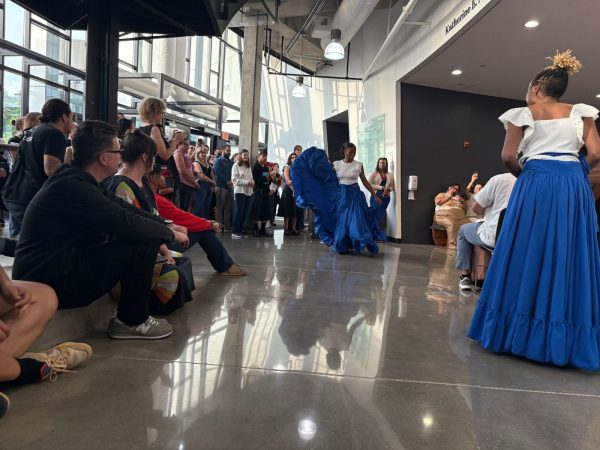
On Sept. 13, viewers observed art pieces, ate Latin cuisine from La Chiva de San Juan food truck and enjoyed traditional Puerto Rican dance performances from the BORIKEN Cultural Center.
Katherine E. Nash Gallery director Teréz Iacovino has worked with José López Serra, the director of Puerto Rican art institute Hidrante, to put together the gallery since 2021. For almost five years, they traveled across the 50 U.S. states and Puerto Rico to connect with artists.
Before becoming director in August, Iacovino served as the Katherine E. Nash Gallery assistant director. She said the idea for “Vaivén” began with the birth of her son in 2019, when she realized she felt estranged from her culture.
“It really started this exploration not only of familial history but cultural history,” Iacovino said. “That really led to me really wanting to work on an exhibition featuring contemporary Puerto Rican art as a way to also learn about Puerto Rican arts and culture.”
Iacovino said the word, vaivén comes from the Spanish term for back and forth movement, and is sometimes used to describe the ease with which Puerto Ricans migrate between the U.S. and Puerto Rico. She said they wanted to explore this concept in many ways, including how the history of migration affects artists.
“That psychological experience of what does it mean to be in diaspora, to experience a place from afar, to not be able to return to a place, to be displaced,” Iacovino said.

Iacovino said she feels more connected to her Puerto Rican heritage after curating the exhibition.
“It felt sort of like a homecoming, in a way of really being welcomed into a community that I felt that I didn’t have access to,” Iacovino said.
Artist Cándida González, featured in the gallery, was raised in Minneapolis. González said growing up in their community, they saw very few Puerto Ricans, but their father kept their culture close.
González said they connected to the theme since their father was banished from his family in Puerto Rico. After his death, she felt they had to connect with their family again.
“That theme of healing, that really shows up in my work,” González said. “How do we use art to heal? How am I using art to heal? How can I offer my art as a healing tool to the community?”
“I did not connect with the island until years later,” González said. “I think that is something that really fuels my art.”
Another feature of the gallery is the mural commission, part of which is displayed in the gallery lobby. The other part is in Rio Piedras, Puerto Rico, and is called “Aquí Nod Quedamos.”
Graduate research assistant Tabatha Cruz co-facilitated community meetings with Puerto Ricans in Minneapolis and Rio Piedras to create the murals. She said they wanted to ensure the murals were unique to each city, while simultaneously being connected.
“Puerto Rico and Minnesota are very far away from each other, and they may seem like opposite spaces of one another, but there are truly some really beautiful connections in between the two,” Cruz said. “Those things are reflected in this mural, especially like the Mississippi, you know, flows all the way into the Gulf, into the Caribbean, and the Caribbean is our home.”
Artist Raysa Rodríguez worked on the mural in Rio Piedras. She said she feels proud of the work she and the other artists accomplished.
“To make community art for me is powerful,” Rodríguez said. “The world needs art to heal, to connect, to learn, to communicate.”
Dancers and musicians from the BORIKEN cultural center performed during the reception. Bomba is a traditional Puerto Rican dance that is done to barilles de bomba (drums), maracas and cuá (wooden sticks).
BORIKEN was founded in 2019, offering art, music, dance and sport programs to preserve cultural traditions. Yari Serrano and her daughter, Jahvi Ortiz, are two Bomba dancers who found community through the organization.
They moved to Minnesota in 2017, after their town in Puerto Rico was flooded by Hurricane Maria. They joined the Bomba workshop five years ago and have performed with the group around the Twin Cities.
“It is therapeutic,” Ortizi said. “I am able to connect to my community, maybe more than I would have back home.”
Yari said she loves promoting the culture, and the program is open to everyone.
“Everyone has rhythm inside them,” Yari said. “This is like a huge family.”