


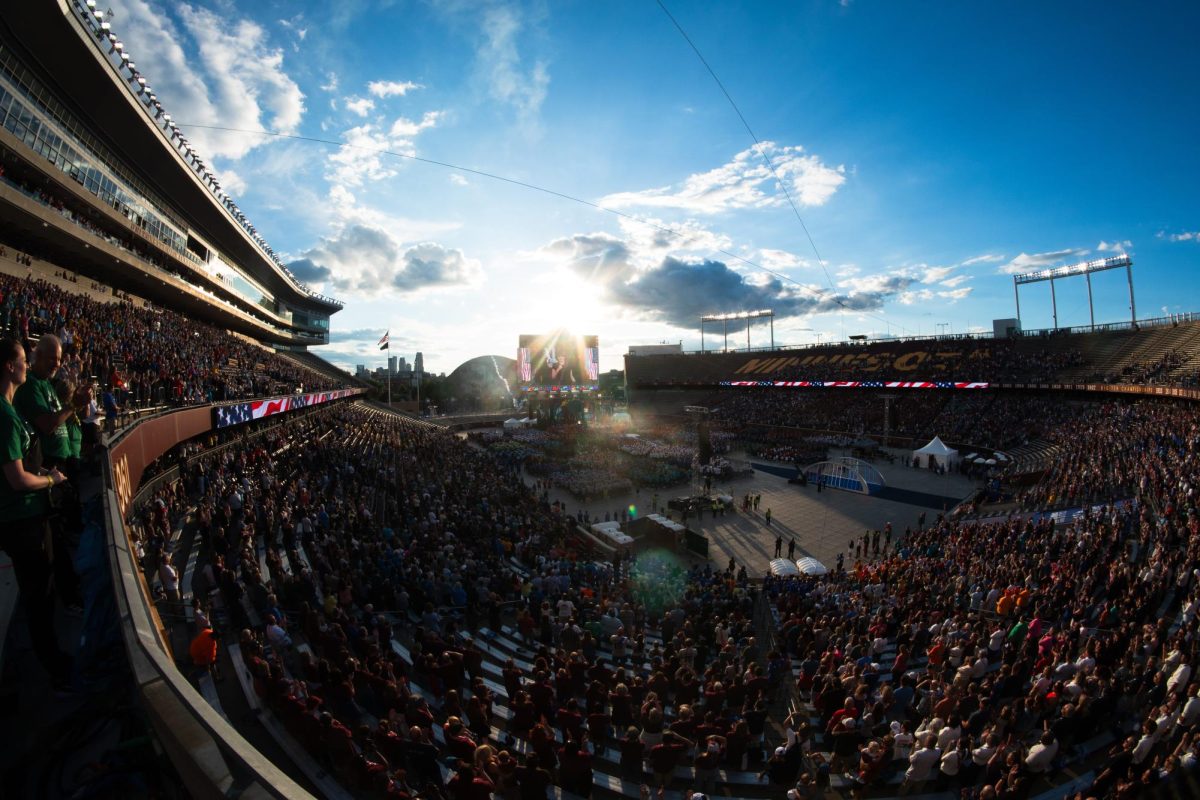
This fall, the University of Minnesota is implementing a new $200 fee for students on the Twin Cities campus to support its athletics department.
The $100-per-semester fee, approved by the Board of Regents in June, comes as schools across the country have gained the ability to pay student athletes directly, following the approval of a landmark National Collegiate Athletic Association settlement.
Commonly referred to as the “House Settlement”, the multi-billion-dollar settlement marks the beginning of direct pay for athletes in college sports and the end of three separate antitrust lawsuits brought against the NCAA for limiting the earnings of college athletes, according to ESPN.
Thousands of former players who played prior to 2021 will additionally be compensated over the next decade up to $2.7 billion, according to NPR.
According to University Public Relations, the current estimated revenue from the fee is $3.5 million per semester and will go towards the Gophers’ athletic facility infrastructure. The fee was approved as a part of this year’s $5.1 billion operating budget, which included the largest tuition hike in over a decade.
Athletics outlined for the Board of Regents in June that the fee will support general infrastructure similar to other campuses, given there is significant usage of athletic facilities by the general student body, according to University Public Relations. The fee was additionally cited in budget documents as a necessary component to supporting current sports programs, amidst a changing financial landscape for Division I sports.
University athletics declined an interview regarding the new fee at this time.
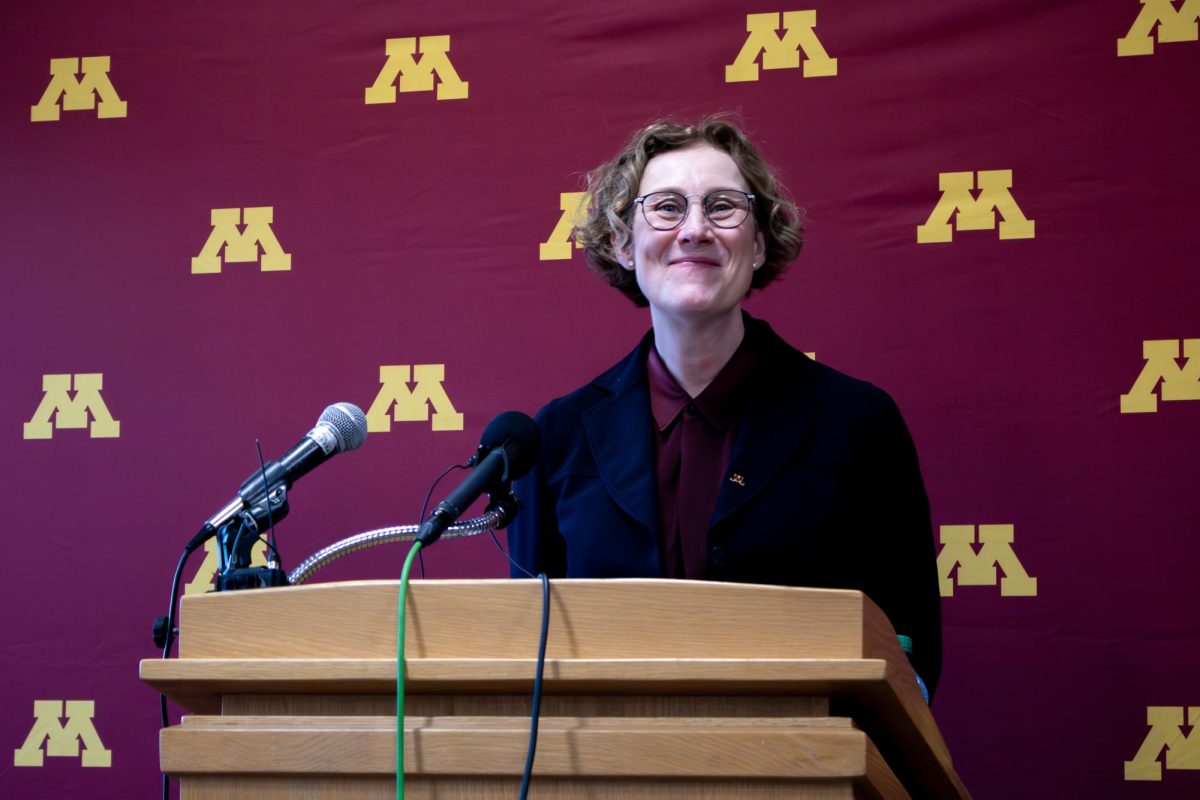
University associate athletic director Paul Rovnak said in an email statement that Gopher Athletics is committed to providing competitive athletic opportunities for its student athletes, and the University’s financial management has put the department in a strong position to adjust to the new college athletics landscape.
“Gopher Athletics will continue to find ways to provide savings, maximize all revenue sources, and support the exceptional academic and athletic success of its student-athletes,” Rovnak said in the statement.
Every school in the Big Ten, the collegiate athletic conference that represents nearly 20 colleges and institutions across the Midwest, has agreed to pay their college athletes the full $20.5 million, which is the maximum financial allotment as of right now under the settlement’s guidelines. The vast majority of funds will go towards football and basketball, according to NIL-NCAA financial reporting.
The University is estimated to pay its football team over $15 million, and its men’s basketball team nearly $4 million in 2025, according to the NIL-NCAA financial reporting. The average revenue shared per player is estimated to be under $150,000 for football and just over $250,000 for men’s basketball.
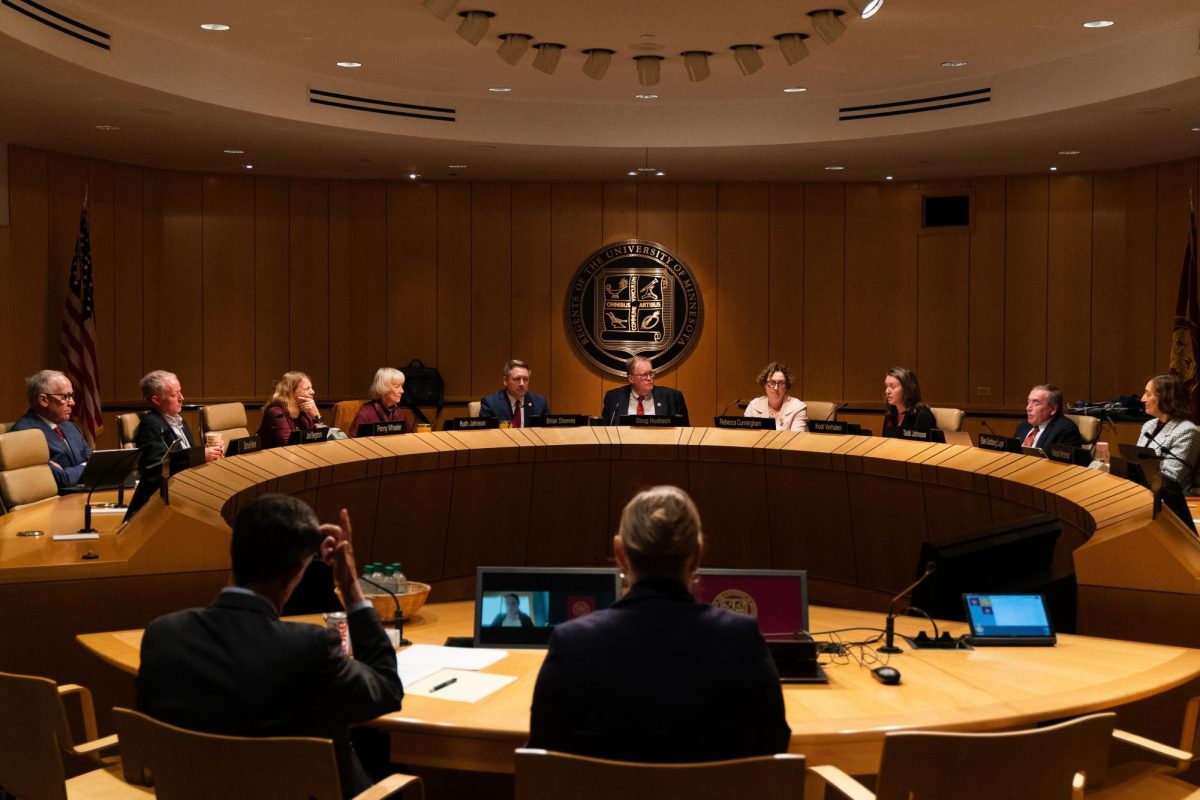
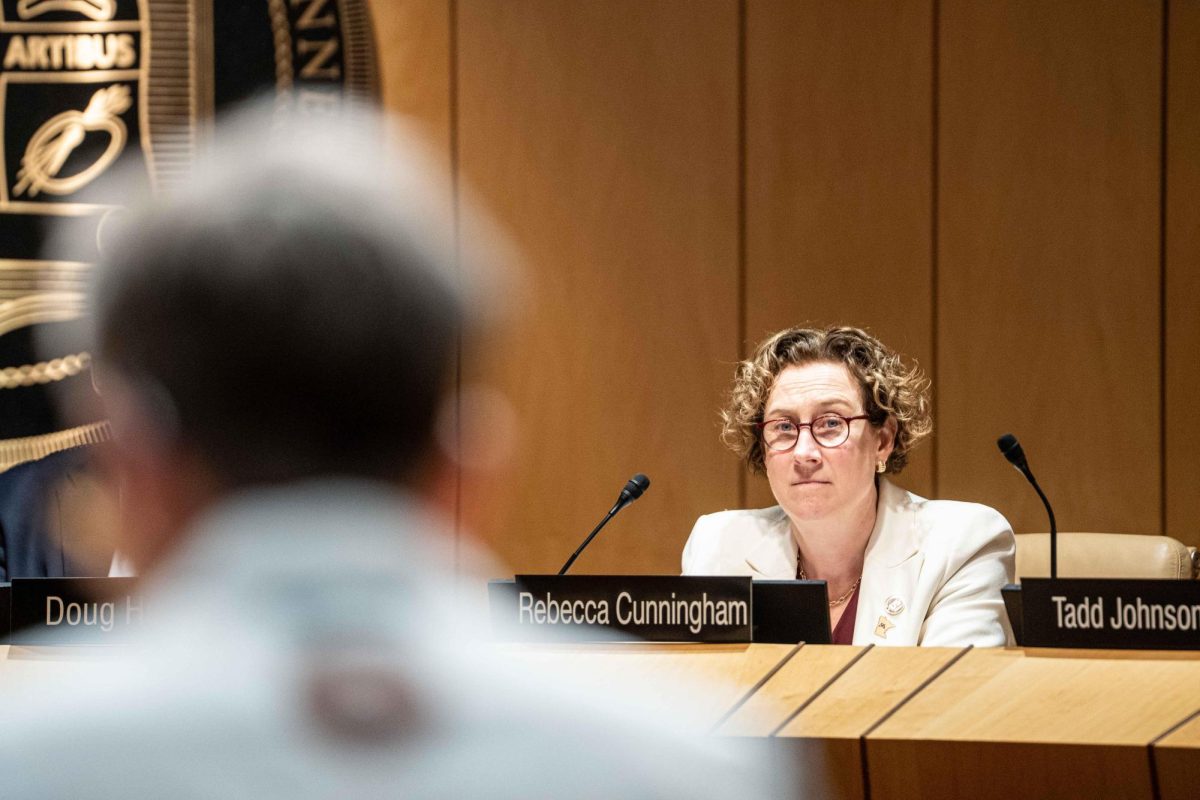
During the July Board of Regents meeting, athletic director Mark Coyle outlined that the University’s commitment to revenue sharing will include men’s hockey, women’s basketball and volleyball. Men’s hockey is estimated to receive just over $1 million in revenue sharing, according to NIL-NCAA financial reporting.
The University athletics department faces a nearly $9 million shortcoming in next year’s $174 million athletic budget, as a result of the new revenue sharing model, according to a report by Kare 11.
According to a report by the Star Tribune, the projected deficit accounts for the $7 million in revenue expected to be generated by the new student fee.
Christopher Pham, a sports and entertainment attorney and partner at law firm Fredrikson & Byron, said the commitment to pay college athletes the $20.5 million will lead to these kinds of deficits, as Universities must reallocate funds to meet the demand.
“Universities get to allocate how the $20.5 million is spent, and it will mostly go towards what is referred to as the ‘revenue-generating sports’,” Pham said. “That’s the reason why men’s football is anticipated to receive 75% of that $20.5 million cap because that’s the highest generating sport.”
Pham said it is very likely there will be legal challenges regarding the settlement in the coming months and years that will continue to shape the legal landscape of college sports. He believes future cases could deal with Title IX, which prohibits discrimination based on sex in education programs, antitrust issues and employment law.
“I think there are enough pundits and experts that believe this is opening the door to these athletes potentially being classified as employees,” Pham said. “Schools would have to then pay payroll taxes, benefits, collective bargaining and all those things.”
Pham said there are several lawsuits moving through the courts now, actively pushing for athletes to be recognized as employees. Still, he said the current phase of college athletics is an evolving legal landscape.
With the House Settlement, Pham said the decision is significant, as it goes beyond what the establishment of Name, Image and Likeness deals were able to accomplish in 2021.
“The biggest fundamental shift is that the schools, for the first time, are paying the athletes directly,” Pham said.
Fourth-year Molly Chevalier said she is commuting to school this year to save money. She said that with the cost of attendance increasing, she wants the University to be more transparent with how the money is being spent.
“It’s already stressful with tuition being raised,” Chevalier said. “If I am going to have to pay $200, they better tell me where every cent is going.”
Chevalier added that if the fee funded something that would benefit all students, not just athletes, it is an expense she would not mind paying.
Fourth-year Smriti Samtani said that because participation in Gopher Athletics is limited, individuals who are not student athletes should not have to bear the burden of paying for compensation.
“Other fees that we all pay for, like the transportation fee or SSF fee (student service fee), we are all eligible to reap the benefits from those,” Samtani said.
The Student Services Fee is a $528.78 fee for undergraduate students enrolled in six or more credits each semester that goes towards different facilities and services, according to the University. How the fee is broken down is publicly available on the University website.
University Athletics did not provide a breakdown of its new athletics fee prior to the deadline provided by the Minnesota Daily.
Third-year Ryan Holoyda said having to pay out-of-state tuition is frustrating enough, on top of now having to pay additional fees. He said he wishes the University would prioritize spending their money more efficiently instead of charging students to make up the difference in order to support athletics.
“The student athletes should be paid, they are working basically a full-time job doing sports and also doing school,” Holoyda said.
Fourth-year Olivia Wavamunno said they feel it is fair to support student athletes, but doesn’t believe the burden should be left to the students through the athletic fee.
“I barely have the funds to support myself,” Wavamunno said. “As someone who’s not involved in athletics at all, I don’t think I should be paying to support that. It’s just another financial burden.”










Chuck
Sep 1, 2025 at 3:48 pm
I used to get calls from the Alumni Association asking me for money. I told them to call me back when the chair of the philosophy department made as much as the football coach.
They’ve stopped calling, but should they call again, now I’ll have to ask them to call me back when the chair of the philosophy department makes as much as the center on the football team.
Transfer Student
Aug 16, 2025 at 6:25 pm
I am a U of MN alumni, but before attending I went to Normandale CC, I attended there for a year before quitting to attend a technical college. After completing my technical college degree and working for a few years I realized I should get a college degree and began attending Normandale to complete my AA to gain acceptance to U of MN. I was amazed at the difference between when I first attended, the students seemed more responsible and focused, there was a lack of “slackers” and “goof offs” that had made it seem like high school in my previous year there. What could account for the change? Then I noticed that all the sports programs had been dropped. There were no longer jocks laying around the commons, which I believe had infected the experience for other students who were there to get an education and improve their lives.
Go fund yourself
Aug 15, 2025 at 9:51 pm
Granted, $200 is small potatoes when it comes to the cost of a UMN education, especially with the huge tuition increase looming. It is really the principle of the fee that is the problem. Why should the average UMN student be responsible for funding elite UMN athletes? The UMN athletic program should be self-funded. There are plenty of ways to either reduce expenses, and/or increase income without making the average UMN student accountable for the athletic department shortfall.
Dana
Aug 1, 2025 at 10:14 am
UMN prof here
So no student fees to support science student salaries to do cutting edge research (which can also promote their education). No student fees to support music, art, drama students salaries for their performances (which can also promote their education). etc.
But student fees to support athletic student salaries to play their chosen sport(s) (which will not promote their education in their major, unless we are going to have a major in pass defense or clock management…actually this latter major would be graduate level as coaches should generally manage the clock.)
UMN regents. Thanks for making your priorities clear.
KG
Aug 1, 2025 at 6:38 am
The $200 Twin Cities student fee for the athlete pay settlement is definitely annoying but isn’t it just small change? Isn’t the focus on a student fee really distracting us and eschewing a bigger issue? What I am talking about is completely revamping CLA and saving the U tens of millions of dollars! Dear student, many dozens of UMN-CLA faculty teach outright racism and falsehoods. Would you consent to dozens of KKK profs monopolizing dozens of tenured and untenured U positions and disseminating their hatred in the classroom? Would you agree that racist professors dominate U hiring committees ensuring that only like-minded racists like them are hired to teach you? Untenured charlatan Nick Estes claimed expertise in architecture and “Palestine” at the Journal of Architectural Education despite no research in either. Melanie Yazzie unabashedly declared her wish to “tear down the United States” at a pro-Palestinian rally, despite regularly receiving her paycheck from UMN. Whole departments—CSCL, GWSS, AIS—teach that the false settler-colonialist narrative applies to Israel-Palestine, and they reinforce one another with the same lies, adding to the semblance of truth. The 2023 CSCL, GWSS, AIS statements on Gaza—described as antisemitic by U faculty—were a coordinated effort, as those academic units have readily admitted. This pernicious narrative denies the truth of the Jews’ 3,000-year continuous habitation of Israel; denies that Jews are indigenous to Israel and that Israel is the Jewish homeland; and, most shockingly, denies the Hamas genocide of Israelis that we all saw—systematic, intentional mass rape, torture, and murder committed on October 7, 2023.
The time has come to disband racist academic units and merge them into broader CLA. The idea is not new. GWSS was on the chopping block a couple of years ago. Other universities, e.g., U of Iowa, have already implemented similar merger policies. While we’re at it, we can terminate all racist, untenured profs, such as Estes and Yazzie. Their racism should have consequences and will save us money.
These structural changes provide year-over-year savings. The U’s budgetary problems require system-wide solutions, so let’s think big. We will also be creating a better and safer campus atmosphere for research, teaching, and study.
Mauricio
Jul 31, 2025 at 6:29 pm
The University is an ACADEMIC institution. They should not be allowed to just make students pay for whatever no one else want to pay. Oh what a tragedy we can’t afford athletics??? The real tragedy is that most students cannot even afford tuition and you force them into debt repayment indenture servitude for the half of their life…
Matt
Jul 31, 2025 at 3:16 pm
At what point will we just accept the writing on the wall? College athletics should be completely separated from their universities and operated like minor league sports programs. The entire mission of universities seems to now revolve around the athletic department and how it can maximize the exploitation of its athletes. And now, when these players begin demanding compensation, the university has to open up it’s checkbook to the detriment of its students. If your business can’t survive on it’s own, then maybe it should cease being a business.
Kat
Jul 31, 2025 at 1:40 pm
As a UMN student and employee, the UMN is making it abundantly clear where they stand in terms of who they protect and who they don’t. Not only is there an expected tuition hike of 6.5%, but now students need to pay fees for other students salaries when students are already scraping by as it is. For employees, UMN does not care about their employees which is apparent in the “offers” UMN brings to the tables in terms of wage, COL, health insurance, parking, etc. But the U has $6 million for a football coach salary, with $1-1.6 million bonuses throughout the contract. AND they have 1/2 a million to add on a 12th VP. Not including what the other 11 VPs make annually.
Don’t get me wrong, I think student athletes should be paid. The amount of revenue they bring in for the U without seeing a dime is shameful. But other students should not be taking the brunt of this, especially if there is no transparency in where this money is going.
KJ
Jul 31, 2025 at 11:40 am
I don’t know, but maybe trimming the multi-million dollar salaries of the University’s top earners would’ve been a better starting point than, say, piling even more financial pressure onto students, many of whom are already scraping by. Asking the University President or some of the coaches to pass on that second vacation home or settle for a slightly smaller yacht doesn’t seem like an outrageous sacrifice, especially when the alternative is forcing students to take on even more debt just to access an education. But sure, let’s keep pretending the only place to find extra money is in students’ already empty pockets.
smh
Jul 31, 2025 at 11:30 am
It’s hard to believe people are going to keep studying at the U. Those of us still here sure look like chumps.
Anonymous
Jul 31, 2025 at 9:20 am
Well it’s pretty simple just become an athlete then.
Carl Flink
Jul 31, 2025 at 7:31 am
As an alumni and employee of this institution, I think the institution should rethink a way to approach this. Many students never attend a single athletic event here. To ask them to pay for activities they will never attend and contribute to other students’ salaries is a real tragedy.
Dis Gusted
Jul 31, 2025 at 12:05 am
Board of Regents just shot themselves in foot. Students won’t stand for frivolous tuition hikes.
Keith Byerly
Jul 30, 2025 at 11:31 pm
I am a UMN graduate and follow these issues. Their fees are too high already. There needs to be legal challenges to this fee. Don’t know what enrollment is not but used to be 50k. That would net 5,000,000 per semester. I can’t believe that many students participate in athletics. The student has little voice in this.
Clay
Jul 30, 2025 at 3:27 pm
If you have a budget shortfall because of having to revenue share 20.5 million dollars then the new student fee that has been instituted is going to exactly that, paying athletes. They can say its going to facilities but lets call a spade a spade. This is a huge injustice to students. They are being forced to subsidize athlete’s salaries. Non athletes taking out loans and working jobs to get through school and pay football/basketball salaries.