Veterans for Peace President Marie Purcell was deployed to Iraq in 2005. She grew up in a military family. She now hopes to mount an anti-war campaign against the Iran war.
Operations in Iran continue, along with the debate about boots on the ground. Veterans discussed their feelings about the war, some against it, while others think the country must do what it can to defend its soldiers.
“I was passively indoctrinated into all the same ideologies that regular Americans are indoctrinated into,” Purcell said.
Purcell’s dad joined the army when she was four years old. Born in Kansas City, going to high school in Hawaii, Purcell moved all over the country. Unsure of where to go, Purcell enlisted directly after high school. While Purcell was not outright anti-war at the start of her military career, these sentiments would brew.
Purcell’s first deployment was to Iraq in 2005, where she worked in military intelligence. One aspect of her job was compiling casualty data, the number of mortalities and those injured. Purcell worked the night shift alone, continually seeing the increase in mortalities. The mental toll on her pushed her to cope by smoking and drinking.
“You have soldiers that are becoming suicidal,” Purcell said. “That are abusing drugs and alcohol, even while deployed, because you can get access to those things. It can start the ball rolling on what then becomes a lifetime of suffering on the basis of the choices that you’re forced to make when you join the military.”
Purcell left the military during her second deployment to Iraq through a conscientious objection. This is where soldiers can leave the military if it is against their beliefs.
She said the hardest time in her life, second to her first deployment, was the year after her second deployment. She dealt with substance abuse. Eleven percent of veterans entering a medical facility run by the U. S. Department of Veterans Affairs for the first time have a substance use disorder.
Upon coming back to civilian life, Purcell was faced with the question of moral injury.
“The only way to heal moral injury is to try to confront that and to do what you can to repair the harm,” Purcell said.
Through her work with VFP, Purcell hopes to heal that moral injury in herself and others. Purcell said she wants to bring veterans together in a place that is holistic and healing. For VFP, it is also about prevention. They hope to be part of creating an anti-war movement to oppose the Iran war and prevent civilians from being recruited.
“This is not going to happen if the young people refuse it,” Purcell said.
She emphasized the purpose of the movement would be to oppose the war, not the soldiers.
“I don’t even want to say anti-war because that has implications that I feel like could turn some vets off,” Purcell said. “If you’re anti-war, then you’re anti the people who participated.”
VFW Post 1782 Commander Gary Carlberg discussed the liabilities around boots on the ground in Iran. His time as a VFW Post Commander is meant to help veterans.
“They need to have boots on the ground because we need to be able to push the enemy back,” Carlberg said. “Anytime you have boots on the ground, you’re going to have more casualties.”
Carlberg came from a military family and served for 37 years. He started in the Minnesota Army National Guard as a private and eventually made the rank of colonel. After deployments to Iraq, Pakistan and Afghanistan, he worked for the Joint Improvised Explosive Device Defeat Organization at the Pentagon.
Carlberg said protestors should not be protesting against the people, bringing up examples of anti-war protests during the Vietnam era. While he supports the right to peaceful protest, he said who the protest is directed towards is important.
He added protest should not be directed towards soldiers, though it could be directed towards politicians on both sides.
“Understand how to separate different things when soldiers are going to war,” Carlberg said. “Don’t shoot the messenger.”
Retired Command Sergeant Major Doug Wortham has an extensive military background. He was first deployed in the Gulf War during Operation Desert Shield. 20 years later, he was deployed in 2009.
Before his first deployment, Wortham went to the recruiter’s office with his high school friend and enlisted. In the years between his first and second deployments, he raised a family.
Wortham grew through the ranks in his time in service. His second deployment to Iraq saw him in a leading role as Sergeant Major.
“I never felt fearful that we couldn’t do what we were supposed to do,” Wortham said. “I felt like we were in the best position we could be in to be successful.”
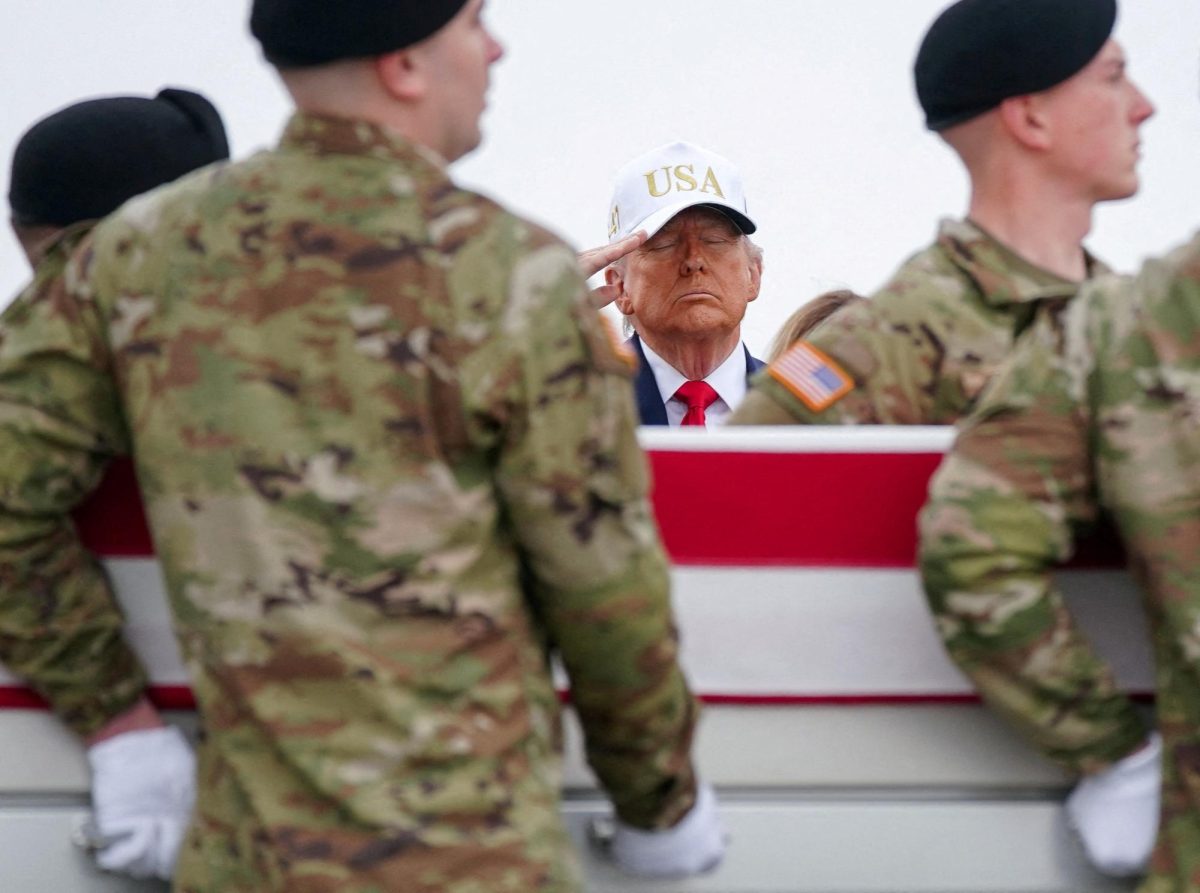
As well-trained as soldiers can be, some things cannot be prepared for. Wortham said he was not prepared for July 16, 2009, when three soldiers in his battalion were killed in action by indirect fire. The enemy was able to get rockets into the perimeter of the camp, Wortham said.
“You have to try to maintain that control,” Wortham said. “And do a dignified transfer of their remains. We had to move them off of the cob so they could be properly processed and get home to their family. That was tough.”
In a leadership position, part of Wortham’s job was to keep morale up. They held a proper ceremony for the fallen soldiers.
Wortham said there needed to be time given to the conflict in Iran before he makes a definitive opinion.
“If we’re sitting here next year, and this thing is still going on, I think that the patience has worn thin,” Wortham said. “I am willing to give it time to let all of the I’s get dotted, the T’s get crossed, and work towards a solution that eliminates the risk that is in Iran.”
He said the conflict between the United States and Iran has been developing for decades. He has faith in the United States military to do what needs to be done.
“I don’t like the fact that we have to send people into harm’s way,” Wortham said. “But that doesn’t mean that it’s not necessary either.”