


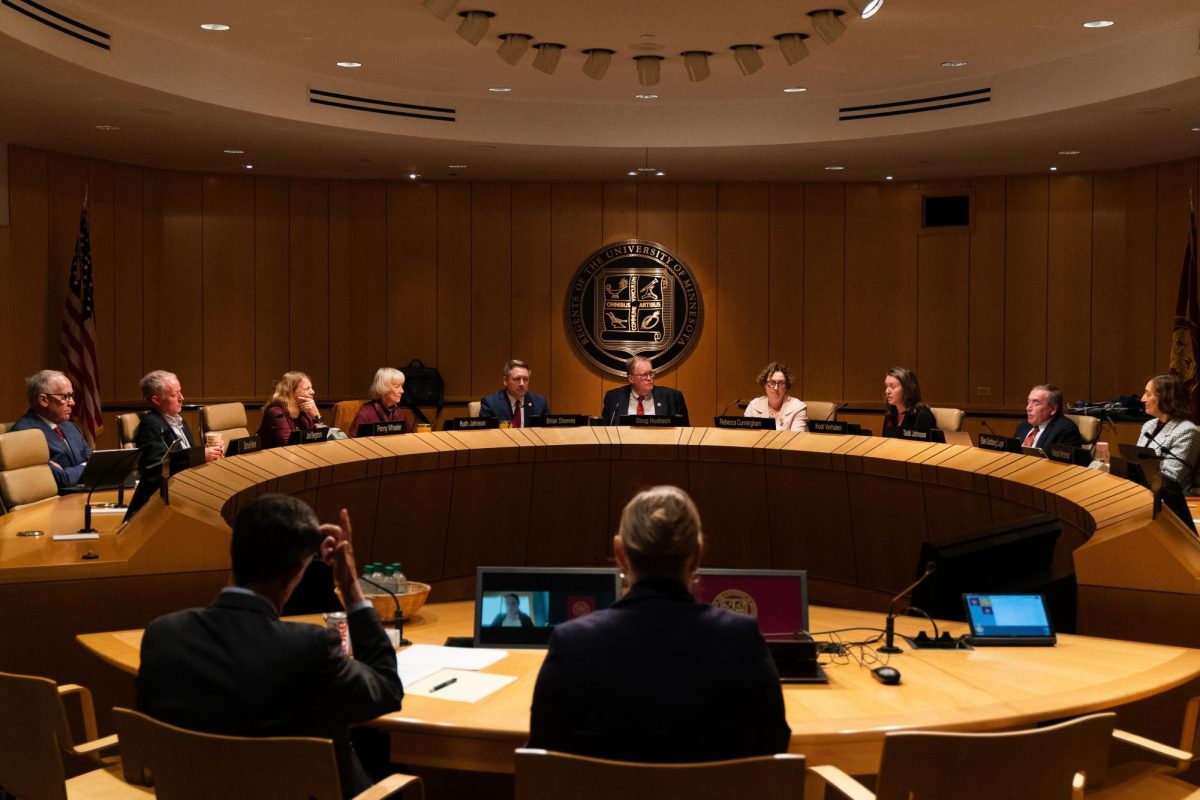
On June 18, the Board of Regents voted to approve a budget that includes widespread cuts to University of Minnesota programs and tuition increases across several campuses. These budget cuts, which include a 7% cut across University programs, have the potential to cause great harm to student job opportunities at the University throughout the state.
David Munkvold, the financial secretary of the University’s Graduate Labor Union, said the University’s administration made these budget changes due to a lack of state funding, which has led them to pursue other, more poorly received financial opportunities.
“The administration is looking for alternative sources of income, since the state isn’t giving the University enough money,” Munkvold said. “Some of those are quite morally dubious, including partnering with weapons manufacturers and private companies that profit off of warfare.”
Munkvold criticized the University’s recent decisions and emphasized that the University needs to pay workers, rather than having a large number of administrative workers who move funding away from student jobs.
“We believe that the University could be doing a lot better job of managing its resources, to actually pay workers rather than having an oversized kind of administrative class of workers,” Munkvold said.
Along with these widespread cuts, the Board plans to decrease research funding by 10.2%, according to the Board of Regents docket material.
Many recent graduates say they struggle with finding job opportunities at the University.
A recent graduate, who chose to stay anonymous due to potential loss of job opportunities, said the job market on campus for both undergraduate and graduate students has been scarce.

They said they applied to multiple research jobs after graduating in the spring, and haven’t even heard back from most of them.
“There was a job that I applied to, and I don’t know if I got rejected from it, but then I saw it was just reposted,” they said. “You can just tell a lot of the employment stuff is just weird.”
They said they got rejected from some of the research job listings they applied for, which required only a high school diploma.
“The qualifications, especially for the ones that I applied for, weren’t extreme,” they said.
Even with the loss of opportunity, some members of the University community see the cuts as beneficial.
In a statement, University President Rebecca Cunningham said she believes the budget cuts will help staff and faculty, as some will see raises and salary increases.
“We have also been moved by calls from the University senate and our faculty and staff who have felt the impacts of soaring inflation,” Cunningham said. “In response to those calls, while other institutions have cut or frozen salaries and benefits, we made the important decision to invest in our people by allocating a significant pool for salary increases.”
Some University members aren’t sold. At the June 18 meeting, Regent Robyn Gulley criticized the budget decisions, claiming the budget plan does nothing to support student workers across the University’s system.
“We would be addressing the subminimum wage for student workers on the Twin Cities campus,” Gulley said. “Whenever we’ve pit workers against each other, the solution isn’t right.”
These budget cuts are not just hurting jobs. The University plans to close and sell the Les Bolstad Golf Course, which employed many student workers, due to financial concerns, according to Fox 9.
In a statement, the University acknowledged the nearly century-old course’s history and impact, but said keeping the land is no longer financially feasible.
“This decision reflects careful consideration and was made in light of today’s challenging financial environment,” the University said in a statement “As a public university, we have a responsibility to ensure that our land and resources are aligned with our core mission: supporting students, advancing research and serving the state of Minnesota.”
In an email statement to the Minnesota Daily, course staff member and incoming senior Elizabeth Morris criticized the potential sale, saying the land could still be used for educational pursuits. She said the course supported her in many different ways as she was battling a brain tumor and helped her connect with the community better.
“I treasure the golf course and will be truly disappointed if the University disposes of the land without considering any other use for it,” Morris said.







Jeff Cohen
Jul 10, 2025 at 6:54 pm
It is pathetic that this opinion piece passes as journalism. The only person who is identified and quoted is an antisemitic union member? It is time for the University to fund programs that show promise for the future, such as it’s once world-famous medical school, business school, and engineering programs. Defund worthless cesspools like Gender, Women, and Sexuality Studies.
KG
Jul 9, 2025 at 10:33 am
When discussing UMN’s budget, are we asking the right questions? UMN’s mission is teaching and research. So, we should be asking whether faculty’s contribution to UMN’s mission is commensurate with its compensation. Sadly, in many cases, the answer is: “No.” Huge sums are expended on worthless academic programs that promote lies, distortions, misinformation, and outright racism. Rachel Hardeman’s recently terminated Center for Antiracism Research for Health Equity (CARHE) within UMN Public Health received millions of dollars. Hardeman not only plagiarized but ran a scam, receiving government grants for research she had no intention of performing, pocketing the money, and gutting her ”research” institute. What was obvious but drew less attention was her virulent antisemitism: her UMN site hosted vicious antisemitic propaganda, and she applauded antisemitism in other media such as LinkedIn. Hardeman’s antisemitism contributed to roiling the UMN campus and metro area, especially through public health personnel over whom she exerted influence.
Antisemitism is akin to the canary in the mine. If an academic unit has deteriorated into crass antisemitism, then its academic validity warrants scrutiny. Consider American Indian Studies (AIS). AIS was nobly founded but has morphed into an antisemitic sewer, a no-go zone for Jews who are proud of their ancestral connection to Israel. AIS antisemitism was publicly on display in its December 2023 manifesto, unanimously signed by AIS faculty. AIS teaches that the settler-colonial narrative falsely applies to Israel-Palestine, even though democratic Israel is demonstrably the ancestral Jewish homeland, which the Jewish people have been continuously inhabiting for 3,000 years.
Let’s look at specific AIS faculty: Nick Estes recently paraded himself as a Journal of Architectural Education Theme Editor for architecture and Israel-Palestine, despite having no demonstrable credentials in these fields. Or consider Melanie Yazzie who said: “I seek to dismantle the United States. I hope you seek to dismantle the United States,” in the Minnesota to Palestine teach-in, December 2023. These people have no tenure. Why do we continue to pay their salaries?
The same is true of CSCL, GWSS and other academic units. Let’s adopt the precedents set by the University of Iowa, Indiana University, Purdue, and others. Let’s combine these marginal academic units into CLA, saving excess administrative costs and terminating antisemitic faculty.