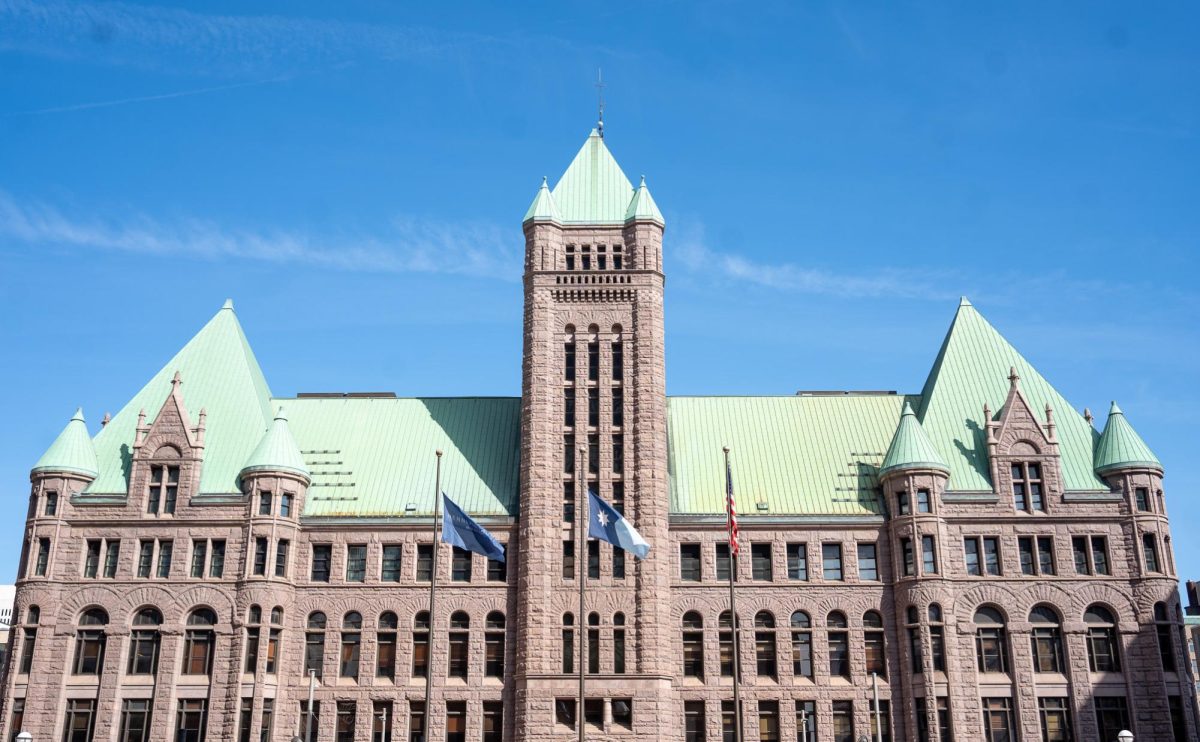
Local leaders from Minneapolis and St. Paul sued the Department of Homeland Security on Jan. 12 due to increasing tensions between ICE and residents in the state.
The Department of Homeland Security announced Operation Metro Surge in early December with the goal of combatting fraud. Now, there are about 3,000 federal agents in the Twin Cities, according to NPR.
Minneapolis Mayor Jacob Frey and St. Paul Mayor Kaohly Her filed a lawsuit against the DHS, claiming the department violated the First and Tenth Amendments.
Richard Painter, a University of Minnesota law professor and legal ethicist who served in the administration of former President George W. Bush, said the state needs to prove the use of ICE deployment is excessive in proportion to what they are addressing.
“The question is whether these ICE deployments are so excessive, and out of proportion to the federal law problem they are purporting to address, that they reach the point where they do violate the Tenth Amendment and in infringing on the right of the state of Minnesota, including law enforcement,” Painter said.
The lawsuit states ICE’s conduct violates the First Amendment right to observe or protest the federal government, specifically following the killing of Renee Good. The suit also cites specific examples of violations, such as protesters being pushed and forcefully detained by ICE.
In a press conference, Minnesota Attorney General Keith Ellison said the operation is a way to target the state.
“This is in essence a federal invasion of the Twin Cities and Minnesota,” Ellison said at a conference. “DHS agents have sown terror across the metropolitan area.”

The Department of Justice said the lawsuit is legally frivolous and motivated by political interest, according to KSTP news. U.S Border Patrol Commander at Large Greg Bovino said there is no end date for the operation, reported the Star Tribune.
Effect of ICE
Local government officials have been vocal in their criticism of ICE. Last week, the Minneapolis
and the St. Paul City Council sent a resolution to Gov. Walz to pass an eviction moratorium, a pause on certain types of evictions.
Eric Hauges, the co-executive director of HOME Line, a non-profit tenant advocacy organization, said the impact of immigration is being felt all across the state, with over 60 of their clients calling about immigration or fear of ICE.
“We have clients who have not left their home in weeks. They’re unable to go to work. We have some clients who are unable to go to work because their place of work is either closed or permanently or temporarily because of immigration enforcement, the impact of immigration enforcement,” Hauges said.
Julia Lora-Versaw, the social media manager of Mujeres Activas en Letras y Cambio Social, said in a statement that the recent ICE raids have made many in the Latino and immigrant community afraid to go outside.
“The recent ICE activity in Minneapolis has created a sense of fear, paranoia, and panic amongst the Latino community. The growing presence of federal immigration agencies threatens not only the safety of our community but also our humanity and our livelihood,” Lora-Versaw said.
Painter said ICE activity will lead to more questions about immigration enforcement efforts in the future.
“The judges will only decide if what they’re doing is illegal. The political question is, what are we going to do about all this ICE business?” Painter said.
Lora-Versaw and Hagues said they are thankful for the state and local government’s work, and hope more can be done for the community.
“It’s amazing that our communities and our neighbors are raising thousands and thousands of dollars of mutual aid, but community care is not, should not have to replace the responsibility of the government to maintain people, to maintain housing stability,” Hauges said. “We need the city, we need the state, we need philanthropy to act.”